Parent guide · Grade 3 German · Unit 2
Lesson 2.1 Null bis zwölf
Written for the parent. The Read aloud parts are written to your child; read them as they are. Do this parts are for you. Answers for you are marked Listen for.
At a glance
- Time
- 3 sessions of 20–30 minutes
- Goal
- Count from 0 to 12 in German. Read and write the numbers 0–12. Study Dürer’s Melencolia I.
- You need
- 13 index cards
- Markers
- A sketchbook or plain paper, and crayons
- A King James Bible
- Worksheet A · the lesson page (it also has a short video (3:30))
Steps
Do this together: Count from zero to twelve in English as fast as you can. Do you notice that eleven and twelve are special? They don’t sound like ten-one and ten-two. German has the same thing! Let’s count in German.
Read aloud: The story. Albrecht Dürer, the great artist of Nuremberg who painted the young hare, was also a fine engraver. He carved pictures into copper plates with a sharp tool, inked them and printed them on paper. In 1514 he made a mysterious engraving called Melencolia I. A winged figure sits with her head on her hand, thinking hard, holding a compass. All around her are tools and puzzles: a ladder, a saw, a ball, a strange stone with many sides, an hourglass, a bell, scales, a sleeping dog. And on the wall behind her hangs a square of sixteen numbers, a magic square. Dürer even hid the year in it: the two middle numbers of the bottom row are 15 and 14, 1514!
Read aloud: Counting in German. null, eins, zwei, drei, vier, fünf, sechs, sieben, acht, neun, zehn, elf, zwölf. Remember: z says ts (zwei, zehn, zwölf), v says f (vier), s before a vowel says z (sechs, sieben), and ei says eye. Just as in English, elf (11) and zwölf (12) are special words. When you count things, say eins alone, but ein before a word: ein Buch.
Read aloud: Writing numbers. Germans write the number one with a long upstroke, like a little roof on top, and they often cross the seven: 7 with a line through the middle, so nobody mistakes it for a one. Try writing your numbers the German way.
Do this: Say each word clearly; your child says it back twice. Point to a picture or the real thing when you can.
- null [NOOL]: zero
- elf [ELF]: eleven
- zwölf [TSVÖLF]: twelve
- die Zahl [dee TSAHL]: number
- zählen [TSAY-lun]: to count
- das Quadrat [dahs kvah-DRAHT]: square
- eins [INES]: one
- zwei [TSVY]: two
- drei [DRY]: three
- zehn [TSAYN]: ten
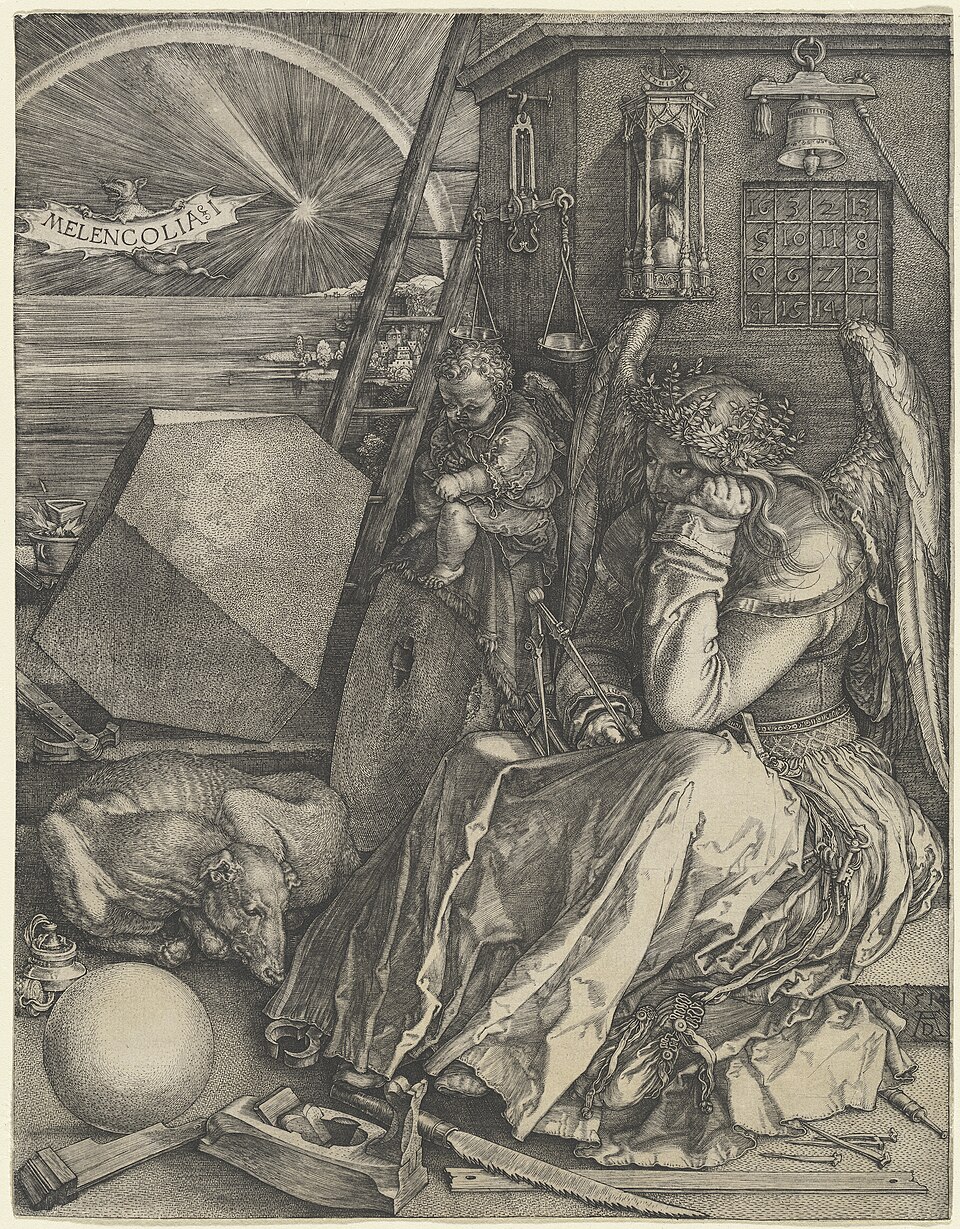
Melencolia I, Albrecht Dürer, 1514. Image: Wikimedia Commons, public domain Do this: Look at the picture together for a quiet minute before anyone talks.
Read aloud: An engraving is printed from lines cut into metal, so every shadow is made of tiny lines and cross-hatching. Dürer filled this picture with symbols of measuring, building and thinking. People have argued for five hundred years about what it all means. But the magic square is clear: it is a real math puzzle.
Point and find:
- Find the square of numbers on the wall. How many numbers does it have?
- Find the hourglass and the bell.
- Find the sleeping dog.
- Find the ladder. How many rungs can you count, in German?
Ask:
- “Why do you think the winged figure looks so thoughtful?”
- “What tools can you name? What is each one for?”
Show: Say 12 in German.
Say this: “Twelve is a special word.”
Say this: “z says ts; ö is round.”
Answer: Zwölf (TSVÖLF).
Show: Count backwards from 5 to 0.
Say this: “Five, four, three, two, one, zero.”
Answer: Fünf, vier, drei, zwei, eins, null.
Do this: Ask out loud. Let your child try first; help only after a real try.
Ask: Say 0 in German.
Listen for: Null.
Ask: Say 11 in German.
Listen for: Elf.
Ask: Say 8 in German.
Listen for: Acht.
3 more on the lesson page.
Read aloud: Make a set of number cards from 0 to 12 with the German word on the back.
Steps:
- On the front of each card, write a numeral 0 to 12 the German way (with the long 1 and the crossed 7).
- On the back, write the German word: null, eins, zwei…
- Shuffle the cards. Look at the numeral and say the German word, then flip to check.
- Then look at the word side and say the number.
Tips for you:
- Time yourself: how fast can you get through all thirteen?
- Play a matching game with a parent.
Done when your child can say:
- I made 13 cards with numbers and words.
- I can say every number from 0 to 12 in German.
Do this: Your child picks one or more; you write the date.
- In your German notebook, write the numbers 0 to 12 with the German word beside each. Copy the first row of Dürer’s magic square: 16, 3, 2, 13.
Read aloud: Dürer was one of the first artists to sell his prints all over Europe. Because a copper plate could print hundreds of copies, ordinary people could buy his art for the first time.
- Saying zwei and zehn with a z sound. Say ts: TSVY, TSAYN.
- Saying vier with a v. Say FEER.
Spread the number cards face up. A parent says a German number; slap the right card first. Then switch.
Say this: “Tell me what you learned today.”
Listen for: Count from 0 to 12 in German.; Read and write the numbers 0–12.; Study Dürer’s Melencolia I.
But the very hairs of your head are all numbered.
In the Luther Bible (1912): <i lang="de">Nun aber sind auch eure Haare auf dem Haupte alle gezählt.</i> God knows us so well that He has numbered every hair on our heads. Nobody can count your hairs, but God knows the number exactly, because He cares for you.
Spread over the week
3 sessions of 20–30 minutes. Stop while it is still going well.
- Session 1. Warm-up, then read and teach the new idea and the new words. Picture study and show how.
- Session 2. Practice together, then start the project. Finish the project, then the sketchbook.
- Session 3. Narration, the game and the Scripture.