Parent guide · Grade 3 German · Unit 3
Lesson 3.1 Der rote Hut
Written for the parent. The Read aloud parts are written to your child; read them as they are. Do this parts are for you. Answers for you are marked Listen for.
At a glance
- Time
- 3 sessions of 20–30 minutes
- Goal
- Name eleven colors in German. Say Der Hut ist rot and der rote Hut. Study August Macke’s Hat Shop.
- You need
- A shoebox or a sheet of cardboard
- Colored paper, scissors, glue
- Toothpicks or straws for hat stands, and modeling clay
- A sketchbook or plain paper, and crayons
- A King James Bible
- Worksheet A · the lesson page (it also has a short video (9:36))
Steps
Do this together: Look at the clothes everyone in your family is wearing today. Name each color in English. Then try the ones you know in German!
Read aloud: The story. A little more than a hundred years ago, a young painter named August Macke lived in the city of Bonn on the Rhine. He loved bright, happy colors and painted people walking in parks, children at the zoo and ladies looking in shop windows. In this painting a lady in a long, deep blue coat with a fur collar stands at the window of a hat shop. Inside, the hats sit on tall stands: a green hat with an orange feather, a black hat with a red brim, a red hat with a dark band. Macke used simple shapes and bright colors side by side, like a stained-glass window. Sadly, he was killed in the First World War in 1914, when he was only twenty-seven.
Read aloud: Colors in sentences. The easy way to use a color is after ist: Der Hut ist rot. (The hat is red.) Die Jacke ist blau. Das Kleid ist grün. The color word does not change at all. When the color comes before the noun, German adds an ending: der rote Hut, die blaue Jacke, das grüne Kleid. After der, die and das, just add -e.
Read aloud: All the colors. rot, orange, gelb, grün, blau, lila, rosa, braun, schwarz, weiß, grau. And when something has many colors, it is bunt. Remember: w says v in weiß, and z says ts in schwarz.
Do this: Say each word clearly; your child says it back twice. Point to a picture or the real thing when you can.
- grau [GROW]: gray
- rosa [ROH-zah]: pink
- lila [LEE-lah]: purple
- bunt [BOONT]: colorful
- der Hut [dehr HOOT]: hat
- der Mantel [dehr MAHN-tel]: coat
- rot [ROHT]: red
- blau [BLOW]: blue
- gelb [GELP]: yellow
- grün [GRÜN]: green
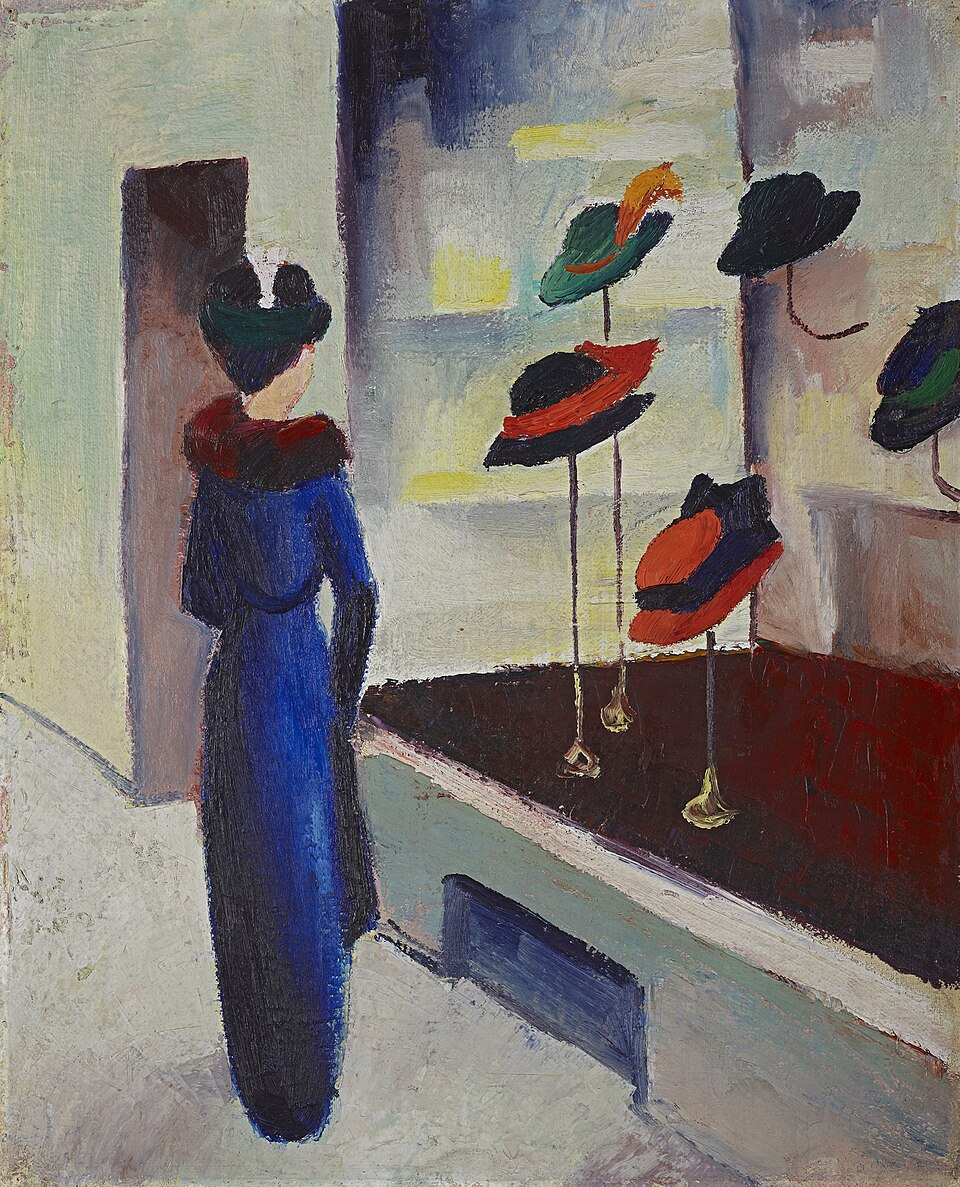
Hat Shop, August Macke, 1913. Image: Wikimedia Commons, public domain Do this: Look at the picture together for a quiet minute before anyone talks.
Read aloud: Macke loved shop windows because they were full of color and light. He painted the lady from behind, so we look into the window with her. Notice how simply he paints: the coat is almost one long blue shape, and the hats are a few strokes of color, yet we know exactly what everything is.
Point and find:
- What color is the lady’s coat? Say it in German.
- Find the hat with the feather. What colors is it?
- Count the hats.
- Find something red.
Ask:
- “Which hat would you choose? Describe it in German.”
- “Why do you think Macke painted the lady from behind?”
Show: Say The jacket is yellow.
Say this: “Jacket is die Jacke.”
Say this: “Use ist and the color.”
Answer: Die Jacke ist gelb.
Show: Say the green hat.
Say this: “Hat is der Hut.”
Say this: “Color before the noun: add -e after der.”
Answer: der grüne Hut.
Do this: Ask out loud. Let your child try first; help only after a real try.
Ask: Say gray in German.
Listen for: Grau.
Ask: Say pink in German.
Listen for: Rosa.
Ask: What does bunt mean?
Listen for: Colorful; many-colored.
3 more on the lesson page.
Read aloud: Make a paper hat shop window and describe each hat in German.
Steps:
- Cut out five paper hats of different colors and shapes.
- Glue each one to a toothpick or straw and stand it in a lump of clay.
- Arrange them in your shoebox window.
- Describe each hat: Der Hut ist grün. Das ist der grüne Hut.
- Play shop: a parent asks Welcher Hut? (Which hat?) and you answer: Der rote Hut, bitte!
Tips for you:
- Add a price tag in German numbers.
- Draw a customer in a blue coat.
Done when your child can say:
- My shop has five colored hats.
- I can describe each one in German.
Do this: Your child picks one or more; you write the date.
- In your German notebook, write all eleven colors with a crayon dot of each color. Write three sentences: Der Hut ist rot. Die Jacke ist blau. Das Kleid ist grün.
Read aloud: August Macke traveled to Tunisia in North Africa in 1914 with his friend Paul Klee. The bright sunlight there inspired some of his most colorful watercolors.
- Adding an ending after ist. Say Der Hut ist rot, not rote.
- Forgetting the ending before a noun. Say der rote Hut.
Play I spy the German way: Ich sehe was, was du nicht siehst, und das ist lila! The others ask Ist es der Stuhl? until they guess right.
Say this: “Tell me what you learned today.”
Listen for: Name eleven colors in German.; Say Der Hut ist rot and der rote Hut.; Study August Macke’s Hat Shop.
Now Israel loved Joseph more than all his children, because he was the son of his old age: and he made him a coat of many colours.
In the Luther Bible (1912): <i lang="de">und machte ihm einen bunten Rock</i> Jacob gave his son Joseph a coat of many colours. Luther called it einen bunten Rock, a colorful coat. Joseph’s brothers were jealous, but God used even their wickedness for good.
Spread over the week
3 sessions of 20–30 minutes. Stop while it is still going well.
- Session 1. Warm-up, then read and teach the new idea and the new words. Picture study and show how.
- Session 2. Practice together, then start the project. Finish the project, then the sketchbook.
- Session 3. Narration, the game and the Scripture.