Parent guide · Grade 2 Biblical Hebrew · Unit 4
Lesson 4.1 The Eh Vowels
Written for the parent. The Read aloud parts are written to your child; read them as they are. Do this parts are for you. Answers for you are marked Listen for.
At a glance
- Time
- 3 sessions of 15–20 minutes
- Goal
- Find segol ֶ and tsere ֵ and say eh and ey. Read letters with segol and tsere. Read the animal words of Isaiah 11:6.
- You need
- Four cards
- Crayons
- A sketchbook or plain paper, and crayons
- A King James Bible
- Worksheet A · the lesson page (it also has a short video (2:55))
Steps
Do this together: Can you imagine a wolf curled up next to a lamb, or a lion lying beside a calf? The prophet Isaiah said that one day in the kingdom of God, even the fiercest animals would live in peace.
Read aloud: The story. Isaiah wrote about the King God would send: The wolf also shall dwell with the lamb, and the leopard shall lie down with the kid… and a little child shall lead them. Christians have long read this as a picture of the peace of Christ’s kingdom. The animal words are full of eh vowels: זְאֵב ze’ev (wolf), כֶּבֶשׂ keves (lamb), נָמֵר namer (leopard).
Read aloud: How Hebrew sounds. Segol is three dots in a little triangle under the letter: בֶּ beh, as in bed. Tsere is two dots side by side: בֵּ bey, as in they. Many teachers simply say eh for both; this course says ey for tsere to help you tell them apart.
Read aloud: Practice. Read: מֶ meh, לֵ ley, כֶּ keh, שֵׁ shey. Then words: מֶלֶךְ MEH-lekh, בֵּן BAYN, לֵב LAYV, שֵׁם SHAYM (name).
Do this: Say each word clearly; your child says it back twice. Point to a picture or the real thing when you can.
- זְאֵב (ze’ev) [zeh-AYV]: wolf
- כֶּבֶשׂ (keves) [KEH-ves]: lamb
- נָמֵר (namer) [nah-MAYR]: leopard
- שֵׁם (shem) [SHAYM]: name
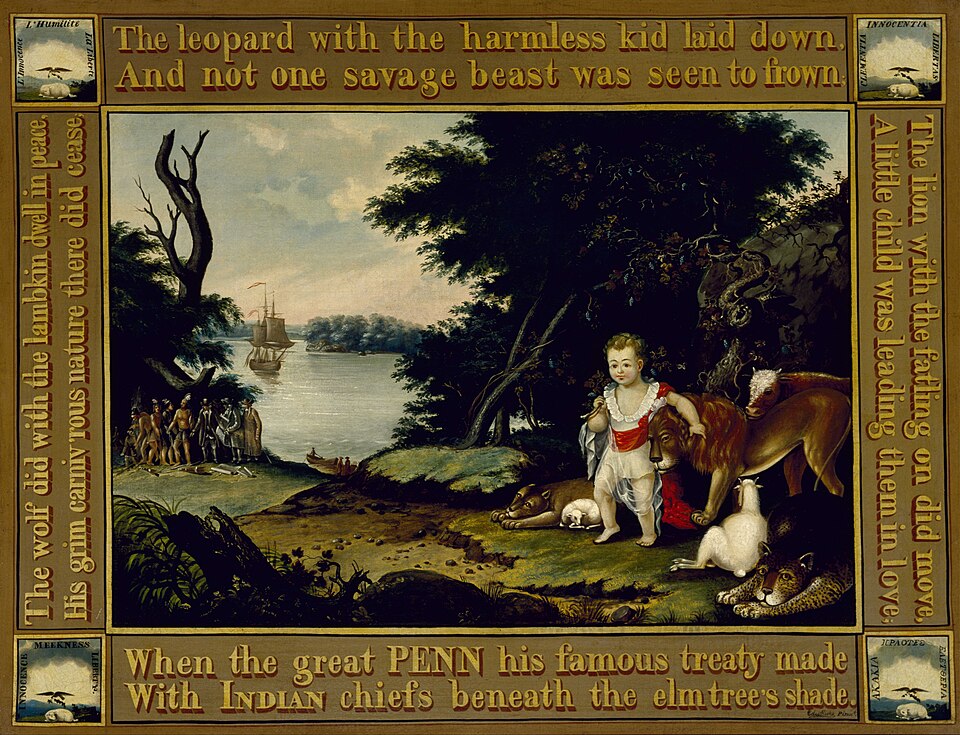
Peaceable Kingdom, Edward Hicks, about 1826. Image: Wikimedia Commons, public domain Do this: Look at the picture together for a quiet minute before anyone talks.
Read aloud: Edward Hicks, a Quaker preacher in Pennsylvania, painted Isaiah’s prophecy more than sixty times. In this version he added William Penn’s peace treaty with the Indians, which he saw as a picture of Isaiah’s peace coming true in his own land.
Point and find:
- Find the little child. Which animal is beside him?
- Find the leopard. What is it doing?
- Find the lamb.
- Read one line of the painted border.
Ask:
- “Why would a wolf and a lamb living together be surprising?”
- “What does Isaiah’s picture teach about the King God promised?”
Show: Read: כֶּבֶשׂ
Say this: “kaf with a dot + segol = keh.”
Say this: “bet without a dot + segol = veh.”
Say this: “sin at the end = s.”
Answer: KEH-ves (lamb).
Show: Read: שֵׁם
Say this: “shin (dot on the right) + tsere = shey.”
Say this: “end-mem = m.”
Answer: SHAYM (name).
Do this: Ask out loud. Let your child try first; help only after a real try.
Ask: Read: בֶּ
Listen for: beh.
Ask: Read: לֵ
Listen for: ley.
Ask: How many dots does segol have?
Listen for: Three.
3 more on the lesson page.
Read aloud: Make animal cards with Hebrew labels.
Steps:
- Draw a wolf, a lamb, a leopard and a goat kid.
- Label them: זְאֵב, כֶּבֶשׂ, נָמֵר, גְּדִי.
- Circle every segol (three dots) in red and every tsere (two dots) in blue.
- Read each label.
Tips for you:
- Count the dots carefully: three for segol, two for tsere.
Done when your child can say:
- My four cards are labeled.
- I can read each one.
Do this: Your child picks one or more; you write the date.
- Write segol and tsere large and label them eh and ey. Copy and read מֶלֶךְ, בֵּן, לֵב, שֵׁם.
Read aloud: Hicks lived in Newtown, Pennsylvania. Before he was a famous painter he painted signs and carriages, and he always said his preaching mattered more than his painting.
- Mixing segol (three dots) and tsere (two dots). Count them.
- Mixing tsere with the colon at the end of a verse (׃). Tsere is under a letter; the verse-end mark sits on the line.
The parent writes a letter with segol or tsere on a whiteboard. Hold up two fingers for tsere or three for segol, then read it. Score a point for each.
Say this: “Tell me what you learned today.”
Listen for: Find segol ֶ and tsere ֵ and say eh and ey.; Read letters with segol and tsere.; Read the animal words of Isaiah 11:6.
The wolf also shall dwell with the lamb, and the leopard shall lie down with the kid; and the calf and the young lion and the fatling together; and a little child shall lead them.
In Hebrew, from the Leningrad Codex: <span class="heb-block" lang="he" dir="rtl">וְגָר זְאֵב עִם־כֶּבֶשׂ וְנָמֵר עִם־גְּדִי</span> This is Isaiah’s picture of the peace of the coming King. Find ze’ev, wolf (second word), keves, lamb, and namer, leopard.
Spread over the week
3 sessions of 15–20 minutes. Stop while it is still going well.
- Session 1. Warm-up, then read and teach the new idea and the new words. Picture study and show how.
- Session 2. Practice together, then start the project. Finish the project, then the sketchbook.
- Session 3. Narration, the game and the Scripture.