Parent guide · Grade 3 Biblical Hebrew · Unit 3
Lesson 3.1 The Vowel Chart
Written for the parent. The Read aloud parts are written to your child; read them as they are. Do this parts are for you. Answers for you are marked Listen for.
At a glance
- Time
- 3 sessions of 20–30 minutes
- Goal
- Group all the vowels by sound: a, e, i, o, u. Read any letter with any vowel. Read the words of Psalm 119:18.
- You need
- Five strips of card
- A brass fastener
- A sketchbook or plain paper, and crayons
- A King James Bible
- Worksheet A · the lesson page (it also has a short video (3:25))
Steps
Do this together: How many vowels does English have? A, E, I, O, U. Hebrew has the same five sounds, but more marks to write them, because some are long and some are short.
Read aloud: The story. About five hundred years ago, a German scholar named Johannes Reuchlin wanted Christians to read the Old Testament in Hebrew. There were almost no books to learn from, so he wrote one: The Rudiments of Hebrew (1506), with a chart of the letters and vowels like the one you are making. Many of the Reformers learned their Hebrew from it.
Read aloud: The chart. a: בַּ patach, בָּ qamets. e: בֶּ segol, בֵּ tsere. i: בִּ hireq, בִּי hireq yod. o: בֹּ holem, בּוֹ holem vav. u: בֻּ qibbuts, בּוּ shureq.
Read aloud: Read it. Psalm 119:18 asks God: Open thou mine eyes, that I may behold wondrous things out of thy law. Before you read the Bible, you can pray that prayer too.
Do this: Say each word clearly; your child says it back twice. Point to a picture or the real thing when you can.
- עַיִן (ayin) [AH-yeen]: eye
- נִפְלָאוֹת (nifla’ot) [nif-lah-OHT]: wondrous things
- תּוֹרָה (torah) [toh-RAH]: law, teaching
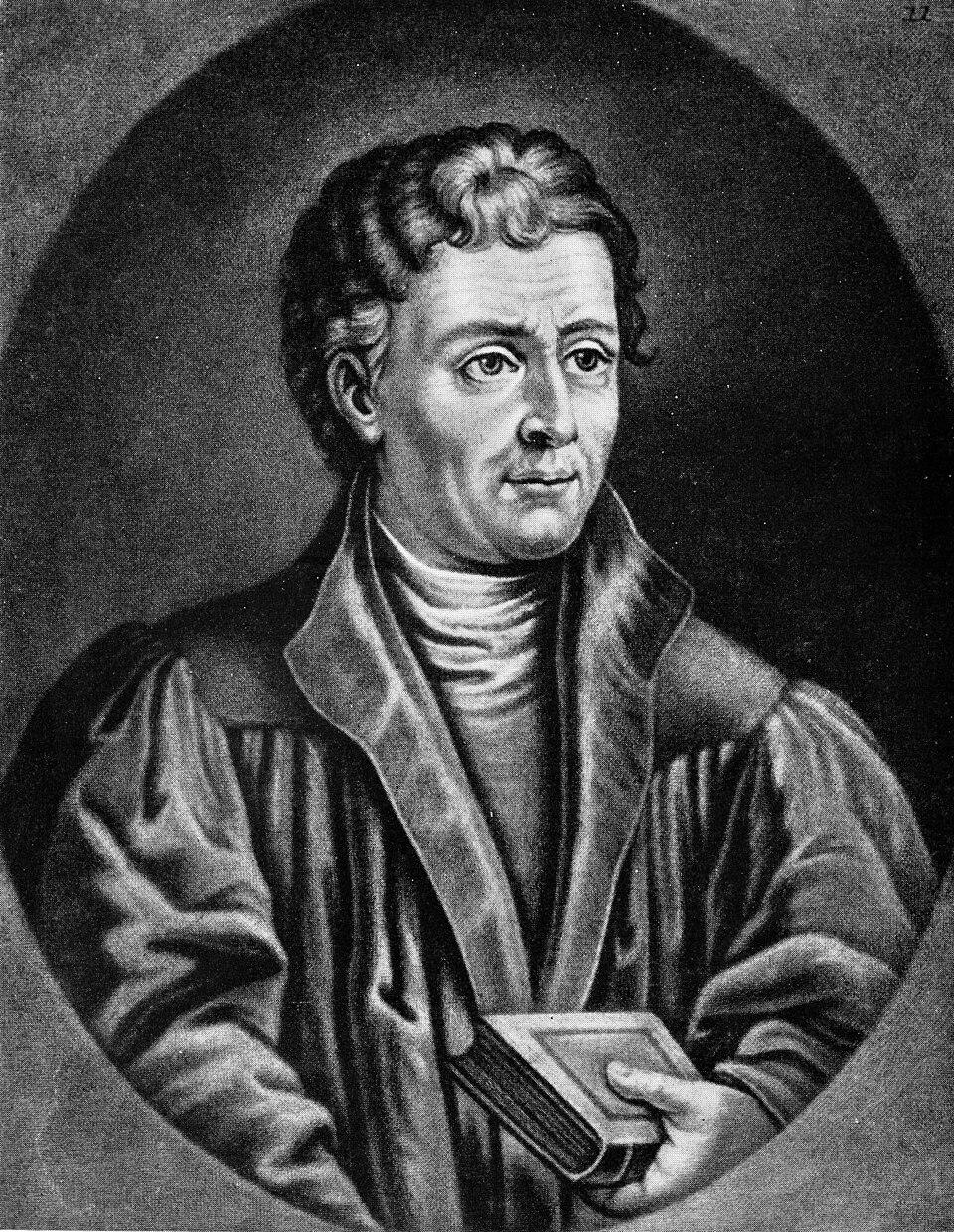
Johannes Reuchlin, Unknown engraver, after a 16th-century likeness. Image: Wikimedia Commons, public domain Do this: Look at the picture together for a quiet minute before anyone talks.
Read aloud: Johannes Reuchlin (1455–1522) was a German lawyer and scholar of Latin, Greek and Hebrew. His Hebrew grammar opened the Old Testament in Hebrew to Christian students. His great-nephew, Philip Melanchthon, became Martin Luther’s close helper.
Point and find:
- What is Reuchlin holding?
- What is he wearing?
- Describe his face: is he stern, kind, thoughtful?
Ask:
- “Why would a Christian scholar want to read the Old Testament in Hebrew?”
- “What book would you hold in your portrait?”
Show: Read: גַּל־עֵינַי
Say this: “gimel + patach = gal; maqqef joins the words.”
Say this: “ayin + tsere yod = ey; nun + patach yod = nai.”
Answer: gal-ey-NAI (open my eyes).
Show: Which sound do בֹּ and בּוֹ share?
Say this: “Both have a dot on top.”
Answer: o.
Do this: Ask out loud. Let your child try first; help only after a real try.
Ask: Read: לָ לֶ לִ לֹ לֻ
Listen for: lah, leh, lee, loh, loo.
Ask: Which two vowels say ah?
Listen for: Patach and qamets.
Ask: Which two say oo?
Listen for: Qibbuts and shureq.
3 more on the lesson page.
Read aloud: Make a fan of vowel cards grouped by sound.
Steps:
- Label the strips a, e, i, o, u.
- On each, write every vowel for that sound under bet, with its name.
- Fasten the strips at one end to make a fan.
- Open the fan to a sound and read the strip.
Tips for you:
- Put the long and short vowels for each sound side by side.
Done when your child can say:
- My fan has all the vowels.
- I can read every strip.
Do this: Your child picks one or more; you write the date.
- Copy the vowel chart and read it across and down.
Read aloud: Reuchlin also defended Jewish books when some wanted them burned, arguing that Christians needed them to understand Hebrew. The long argument made him famous across Europe.
- Forgetting that qamets and patach both say a.
- Reading vowel letters (וֹ, וּ, ִי) as consonants.
Make a die with a, e, i, o, u and ? (any) on its sides. Roll it and read a letter card with a vowel of that sound. The ? side lets you choose.
Say this: “Tell me what you learned today.”
Listen for: Group all the vowels by sound: a, e, i, o, u.; Read any letter with any vowel.; Read the words of Psalm 119:18.
Open thou mine eyes, that I may behold wondrous things out of thy law.
Hebrew (Westminster Leningrad Codex, vowel points shown, cantillation marks left out): <span class="heb-block" lang="he" dir="rtl">גַּל־עֵינַי וְאַבִּיטָה נִפְלָאוֹת</span> Read gal-‘eynai, open my eyes, then ve’abbitah, that I may behold. Find the a, e, i and o vowels.
Spread over the week
3 sessions of 20–30 minutes. Stop while it is still going well.
- Session 1. Warm-up, then read and teach the new idea and the new words. Picture study and show how.
- Session 2. Practice together, then start the project. Finish the project, then the sketchbook.
- Session 3. Narration, the game and the Scripture.