Parent guide · Grade 3 Biblical Hebrew · Unit 2
Lesson 2.2 Qibbuts and Shureq, the U Vowels
Written for the parent. The Read aloud parts are written to your child; read them as they are. Do this parts are for you. Answers for you are marked Listen for.
At a glance
- Time
- 3 sessions of 20–30 minutes
- Goal
- Find qibbuts ֻ and shureq וּ and say oo. Tell shureq וּ from vav with dagesh. Read רוּת, רוּחַ, סוּס, הוּא.
- You need
- Two cards
- Markers
- A sketchbook or plain paper, and crayons
- A King James Bible
- Worksheet A · the lesson page (it also has a short video (2:15))
Steps
Do this together: Pucker your lips like an owl and hoot: oooo! Today’s two vowels both say oo. One is three slanting dots; the other is a vav with a dot in its middle.
Read aloud: The story. When Naomi’s husband and sons died in Moab, she decided to go home to Bethlehem. Her daughter-in-law Ruth would not leave her: Intreat me not to leave thee… thy people shall be my people, and thy God my God. Ruth trusted the God of Israel, and she became the great-grandmother of King David. Her name, רוּת, has the oo vowel.
Read aloud: How Hebrew sounds. Qibbuts is three dots slanting down under a letter: בֻּ boo. Shureq is a vav with a dot in its middle, וּ, and it also says oo: סוּס SOOS. Words: רוּת ROOT (Ruth), רוּחַ ROO-akh (spirit), הוּא HOO (he).
Read aloud: Careful. In רוּחַ, the patach under the final chet is read before it: ROO-akh, not ROO-khah. This is called a furtive patach; you will meet it again in Grade 4.
Do this: Say each word clearly; your child says it back twice. Point to a picture or the real thing when you can.
- רוּת (Rut) [ROOT]: Ruth
- רוּחַ (ruach) [ROO-akh]: spirit; wind; breath
- סוּס (sus) [SOOS]: horse
- הוּא (hu) [HOO]: he
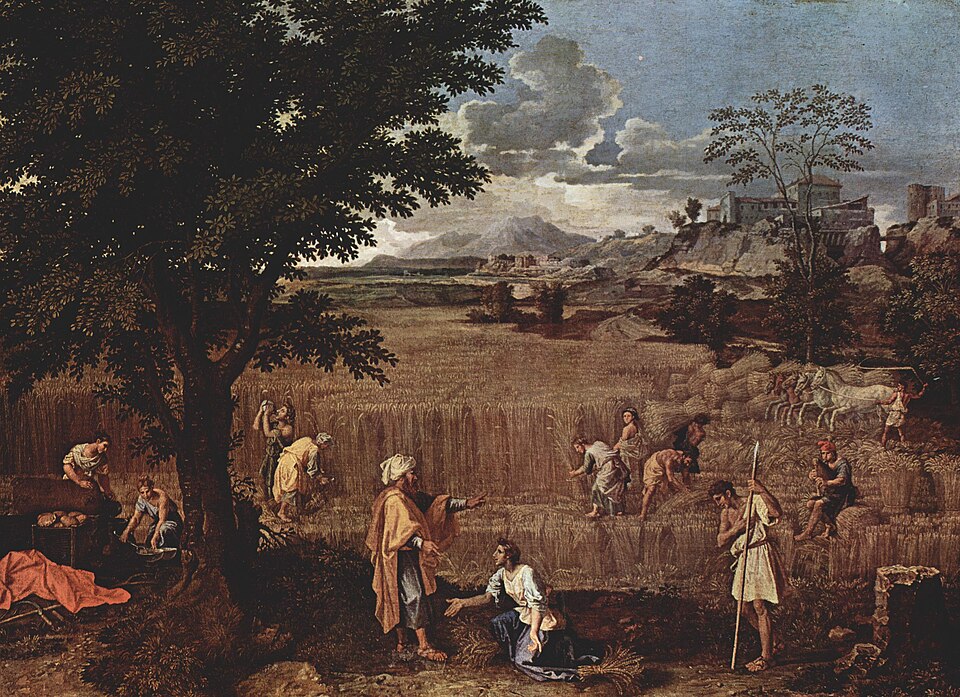
Summer (Ruth and Boaz), Nicolas Poussin, 1660–1664. Image: Wikimedia Commons, public domain Do this: Look at the picture together for a quiet minute before anyone talks.
Read aloud: Poussin was a French painter who worked in Rome. At the end of his life he painted the four seasons as four Bible stories; summer is Ruth gleaning in the field of Boaz.
Point and find:
- Find Ruth kneeling. What is she holding?
- Find Boaz in the golden cloak.
- What are the horses doing at the right?
- Find the town on the hill.
Ask:
- “Why might Poussin choose Ruth’s story for summer?”
- “How did Ruth show faithfulness?”
Show: Read: סוּס
Say this: “samekh = s.”
Say this: “vav with a middle dot = oo.”
Say this: “samekh = s.”
Answer: SOOS (horse).
Show: Is this holem or shureq? וּ
Say this: “Where is the dot: on top, or in the middle?”
Say this: “In the middle.”
Answer: Shureq: oo.
Do this: Ask out loud. Let your child try first; help only after a real try.
Ask: Read: בֻּ
Listen for: boo.
Ask: Read: רוּת
Listen for: Root (Ruth).
Ask: What does ruach mean?
Listen for: Spirit, wind, breath.
3 more on the lesson page.
Read aloud: Make two owl cards, one for each oo vowel.
Steps:
- Draw an owl on each card.
- On one owl’s belly write qibbuts under three letters: בֻּ, כֻּ, לֻ.
- On the other write shureq words: רוּת, סוּס, הוּא.
- Hoot oo and read each.
Tips for you:
- Shureq’s dot is in the middle of the vav, not on top.
Done when your child can say:
- My owls show both oo vowels.
- I can read every word.
Do this: Your child picks one or more; you write the date.
- Copy רוּת, רוּחַ, סוּס, הוּא, כֻּלָּם and circle the oo vowels.
Read aloud: Ruth is one of only two books of the Bible named after a woman (the other is Esther), and Ruth is named in the family line of Jesus in Matthew 1:5.
- Mixing וֹ (o, dot on top) and וּ (oo, dot in the middle).
- Reading רוּחַ as roo-khah. The patach under a final chet is read first: ROO-akh.
The parent points to a word on the chart. Make a round O with your arms for holem words and hoot like an owl for oo words, then read the word.
Say this: “Tell me what you learned today.”
Listen for: Find qibbuts ֻ and shureq וּ and say oo.; Tell shureq וּ from vav with dagesh.; Read רוּת, רוּחַ, סוּס, הוּא.
And Ruth said, Intreat me not to leave thee, or to return from following after thee: for whither thou goest, I will go; and where thou lodgest, I will lodge: thy people shall be my people, and thy God my God:
Hebrew (Westminster Leningrad Codex, vowel points shown, cantillation marks left out): <span class="heb-block" lang="he" dir="rtl">וַתֹּאמֶר רוּת אַל־תִּפְגְּעִי־בִי</span> Find Rut, Ruth, the second word: resh, shureq, tav.
Spread over the week
3 sessions of 20–30 minutes. Stop while it is still going well.
- Session 1. Warm-up, then read and teach the new idea and the new words. Picture study and show how.
- Session 2. Practice together, then start the project. Finish the project, then the sketchbook.
- Session 3. Narration, the game and the Scripture.