Parent guide · Grade 2 Mandarin · Unit 4
Lesson 4.1 衣服, 裤子, 鞋: What I Wear
Written for the parent. The Read aloud parts are written to your child; read them as they are. Do this parts are for you. Answers for you are marked Listen for.
At a glance
- Time
- 3 sessions of 15–20 minutes
- Goal
- Say 衣服, 裤子, 裙子, 鞋, 帽子 and 袜子. Say 我穿… (I wear…). Learn how silk was discovered in China.
- You need
- Card stock, crayons, scissors (a parent helps)
- Tape or tabs
- A sketchbook or plain paper, and crayons
- A King James Bible
- Worksheet A · the lesson page (it also has a short video (1:30))
Steps
Do this together: Get dressed in a silly way: shoes on hands, hat on a foot! Then fix it. What do we call each thing? Today we learn clothes in Chinese.
Read aloud: The story. Jesus said, “Why take ye thought for raiment? Consider the lilies of the field.” God clothes the flowers beautifully, and He will take care of His children. Long ago, the Chinese discovered how to make silk from the cocoons of silkworms, and Chinese silk became famous around the world.
Read aloud: How Chinese works. 穿 means to wear: 我穿鞋 (I wear shoes). Many clothing words end in a light 子 (zi): 裤子, 裙子, 帽子, 袜子.
Read aloud: Say it out loud. yīfu (EE-foo), kùzi (KOO-dzuh), qúnzi (CHÜN-dzuh), xié (shyeh), màozi (MAO-dzuh), wàzi (WAH-dzuh).
Do this: Say each word clearly; your child says it back twice. Point to a picture or the real thing when you can.
- 衣服 (yīfu) [EE-foo]: clothes; shirt
- 裤子 (kùzi) [KOO-dzuh]: pants
- 裙子 (qúnzi) [CHÜN-dzuh]: skirt; dress
- 鞋 (xié) [shyeh (rising)]: shoes
- 帽子 (màozi) [MAO-dzuh]: hat
- 穿 (chuān) [chwahn (high)]: to wear
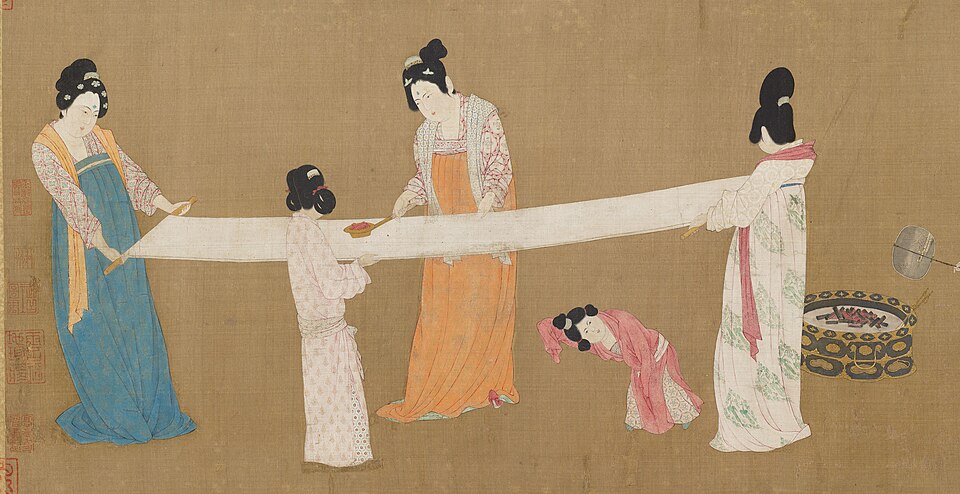
Court Ladies Preparing Newly Woven Silk (detail), Emperor Huizong, after Zhang Xuan, early 12th century copy of an 8th-century painting. Image: Wikimedia Commons, public domain Do this: Look at the picture together for a quiet minute before anyone talks.
Read aloud: In old China, silk cloth was made by hand. These ladies have just woven a long piece of silk, and now they stretch it and smooth it with a pan of hot coals, like an iron. The painting was copied by Emperor Huizong from an older Tang-dynasty painting.
Point and find:
- How many ladies hold the silk?
- Find the little girl. What is she doing?
- What colors are their clothes?
- Find the pan they use as an iron.
Ask:
- “How long do you think it took to make this cloth?”
- “What is your favorite piece of clothing?”
Show: Say “I wear a hat.”
Say this: “Wear = 穿 (for hats, 戴 dài is also used).”
Say this: “Hat = 帽子.”
Answer: 我戴帽子 (wǒ dài màozi). 我穿… is used for clothes and shoes.
Show: What is 鞋?
Say this: “We wear it on our feet.”
Answer: Shoes.
Do this: Ask out loud. Let your child try first; help only after a real try.
Ask: Say pants in Chinese.
Listen for: 裤子 (kùzi).
Ask: What is 裙子?
Listen for: A skirt or dress.
Ask: Say “I wear shoes.”
Listen for: 我穿鞋.
1 more on the lesson page.
Read aloud: Make a paper doll with clothes to change.
Steps:
- Draw and cut out a simple doll.
- Draw clothes: 衣服, 裤子, 裙子, 鞋, 帽子.
- Dress the doll and say 她穿… or 他穿….
- Change clothes and say it again.
Tips for you:
- He = 他, she = 她: both are tā.
Done when your child can say:
- My doll has five pieces of clothing.
- I said what it wears in Chinese.
Do this: Your child picks one or more; you write the date.
- Draw yourself in your favorite clothes. Label each piece.
Read aloud: For hundreds of years, China kept the making of silk a secret. Traders carried silk west along the Silk Road all the way to Rome.
- Using 穿 for a hat. Chinese usually says 戴帽子 (dài màozi) for hats, glasses and gloves.
- Saying 鞋 xié as “she.” It is shyeh, rising.
The child tells the parent what to put on in Chinese: 穿鞋! 戴帽子! The parent does it (sometimes in a silly way, and the child corrects in Chinese).
Say this: “Tell me what you learned today.”
Listen for: Say 衣服, 裤子, 裙子, 鞋, 帽子 and 袜子.; Say 我穿… (I wear…).; Learn how silk was discovered in China.
And why take ye thought for raiment? Consider the lilies of the field, how they grow; they toil not, neither do they spin:
In the Chinese Bible (Chinese Union Version), this verse reads: <span class="zh-block" lang="zh-Hans">何必为衣裳忧虑呢?你想野地里的百合花怎么长起来</span><span class="py-line">Hé bì wèi yī shang yōu lǜ ne? Nǐ xiǎng yě dì lǐ de bǎi hé huā zěn me zhǎng qǐ lái</span> Jesus told us not to worry about clothes. God dresses the lilies, and He cares for us even more.
Spread over the week
3 sessions of 15–20 minutes. Stop while it is still going well.
- Session 1. Warm-up, then read and teach the new idea and the new words. Picture study and show how.
- Session 2. Practice together, then start the project. Finish the project, then the sketchbook.
- Session 3. Narration, the game and the Scripture.