Parent guide · Grade 2 Mandarin · Unit 5
Lesson 5.1 春夏秋冬: The Four Seasons
Written for the parent. The Read aloud parts are written to your child; read them as they are. Do this parts are for you. Answers for you are marked Listen for.
At a glance
- Time
- 3 sessions of 15–20 minutes
- Goal
- Say 春天, 夏天, 秋天 and 冬天. Tell one thing about each season. Say 我喜欢… (I like…).
- You need
- A paper plate, crayons, a paper arrow, a brass fastener
- A sketchbook or plain paper, and crayons
- A King James Bible
- Worksheet A · the lesson page (it also has a short video (2:52))
Steps
Do this together: What season is it now? What do you see outside? What do you wear? What do you like to do in this season?
Read aloud: The story. King Solomon wrote, “To every thing there is a season.” God planned spring for planting, summer for growing, autumn for harvest and winter for rest. Each season shows His care.
Read aloud: How Chinese works. Each season is one character + 天 (day, sky): 春天, 夏天, 秋天, 冬天. To say what you like, use 我喜欢: 我喜欢夏天!
Read aloud: Say it out loud. chūn (chwun), xià (shyah), qiū (chyoh), dōng (dong). Chant them in order: 春, 夏, 秋, 冬!
Do this: Say each word clearly; your child says it back twice. Point to a picture or the real thing when you can.
- 春天 (chūntiān) [chwun-TYEN]: spring
- 夏天 (xiàtiān) [shyah-TYEN]: summer
- 秋天 (qiūtiān) [chyoh-TYEN]: autumn; fall
- 冬天 (dōngtiān) [dong-TYEN]: winter
- 喜欢 (xǐhuan) [SHEE-hwahn]: to like
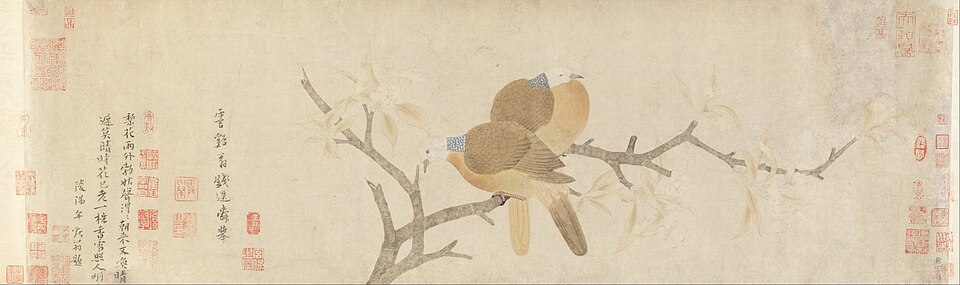
Doves and Pear Blossoms after Rain, Qian Xuan, late 13th century (Yuan dynasty). Image: Wikimedia Commons, public domain Do this: Look at the picture together for a quiet minute before anyone talks.
Read aloud: Qian Xuan was a painter who lived about seven hundred and fifty years ago. He painted two doves resting on a pear tree after a spring rain. The writing on the left is a poem, and the red marks are seals stamped by people who owned and loved the painting.
Point and find:
- How many doves do you see? Say it in Chinese.
- What color are the blossoms?
- Find the red seal stamps.
- What season is it in this painting?
Ask:
- “Why do you think the doves sit so close together?”
- “What do you like best about spring?”
Show: In which season do leaves turn red and fall?
Say this: “That is autumn.”
Say this: “Autumn = 秋天.”
Answer: 秋天 (qiūtiān).
Show: Say “I like winter.”
Say this: “I like = 我喜欢.”
Say this: “Winter = 冬天.”
Answer: 我喜欢冬天.
Do this: Ask out loud. Let your child try first; help only after a real try.
Ask: Say spring in Chinese.
Listen for: 春天 (chūntiān).
Ask: Say summer in Chinese.
Listen for: 夏天 (xiàtiān).
Ask: Name the four seasons in order.
Listen for: 春天, 夏天, 秋天, 冬天.
1 more on the lesson page.
Read aloud: Make a wheel of the four seasons.
Steps:
- Divide the plate into four parts.
- Draw a picture for each season and write 春, 夏, 秋, 冬.
- Fasten the arrow.
- Point to the season now and say 现在是…天 (now it is…).
Tips for you:
- Go around in order: 春, 夏, 秋, 冬.
Done when your child can say:
- My wheel shows four seasons.
- I can say them in Chinese.
Do this: Your child picks one or more; you write the date.
- Draw your favorite season. Write 我喜欢 and the season name.
Read aloud: The old Chinese farming calendar divided the year into twenty-four little seasons, with names like Grain Rain and Insects Awaken, to tell farmers when to plant and harvest.
- Mixing 秋 qiū (autumn) and 九 jiǔ (nine). 秋 is high and level.
- Saying 喜欢 with two strong beats. The huan is light.
Play music. When it stops, the parent calls a season in Chinese and the child freezes in a pose: 春天 (a growing flower), 夏天 (swimming), 秋天 (raking leaves), 冬天 (shivering).
Say this: “Tell me what you learned today.”
Listen for: Say 春天, 夏天, 秋天 and 冬天.; Tell one thing about each season.; Say 我喜欢… (I like…).
To every thing there is a season, and a time to every purpose under the heaven:
In the Chinese Bible (Chinese Union Version), this verse reads: <span class="zh-block" lang="zh-Hans">凡事都有定期,天下万务都有定时。</span><span class="py-line">Fán shì dōu yǒu dìng qī, tiān xià wàn wù dōu yǒu dìng shí.</span> God has a time for everything. The seasons come and go just as He planned.
Spread over the week
3 sessions of 15–20 minutes. Stop while it is still going well.
- Session 1. Warm-up, then read and teach the new idea and the new words. Picture study and show how.
- Session 2. Practice together, then start the project. Finish the project, then the sketchbook.
- Session 3. Narration, the game and the Scripture.