Parent guide · Grade 3 Mandarin · Unit 1
Lesson 1.1 The Four Tones: mā má mǎ mà
Written for the parent. The Read aloud parts are written to your child; read them as they are. Do this parts are for you. Answers for you are marked Listen for.
At a glance
- Time
- 3 sessions of 20–30 minutes
- Goal
- Say and hear the four tones and the light tone. Read tone marks in pinyin. Understand that a change of tone changes the meaning.
- You need
- Four index cards
- Markers
- A King James Bible
- Worksheet A · the lesson page (it also has a short video (3:57))
Steps
Do this together: Say “yes” four ways: happy and high, as a question, unsure, and firm like a command. Your voice went up and down. In Chinese, those ups and downs change the meaning of a word!
Read aloud: The big idea. In English, a word means the same thing however you say it. In Mandarin, the tone is part of the word. 妈 (high) is mother, 麻 (rising) is hemp, 马 (dipping) is horse, and 骂 (falling) is to scold. Then 吗 with no mark is light and short: it turns a sentence into a question.
Read aloud: How pinyin shows it. Pinyin puts the tone mark over the main vowel: ā á ǎ à. Draw it in the air as you say it: a flat line, a line going up, a check mark, and a line going down.
Read aloud: Two tone rules. When two third tones come together, the first one rises: 你好 is written nǐ hǎo but said ní hǎo. And 不 (bù) becomes bú before a fourth tone: 不是 bú shì.
Read aloud: Practice. Say 妈妈骂马吗? (Māma mà mǎ ma? Does Mom scold the horse?) slowly, then fast. Every tone is there!
Do this: Say each word clearly; your child says it back twice. Point to a picture or the real thing when you can.
- 妈 (mā) [mah (first tone)]: mother
- 麻 (má) [mah (second tone)]: hemp
- 马 (mǎ) [mah (third tone)]: horse
- 骂 (mà) [mah (fourth tone)]: to scold
- 吗 (ma) [mah (light tone)]: question particle
- 声调 (shēngdiào) [shung-DYOW]: tone
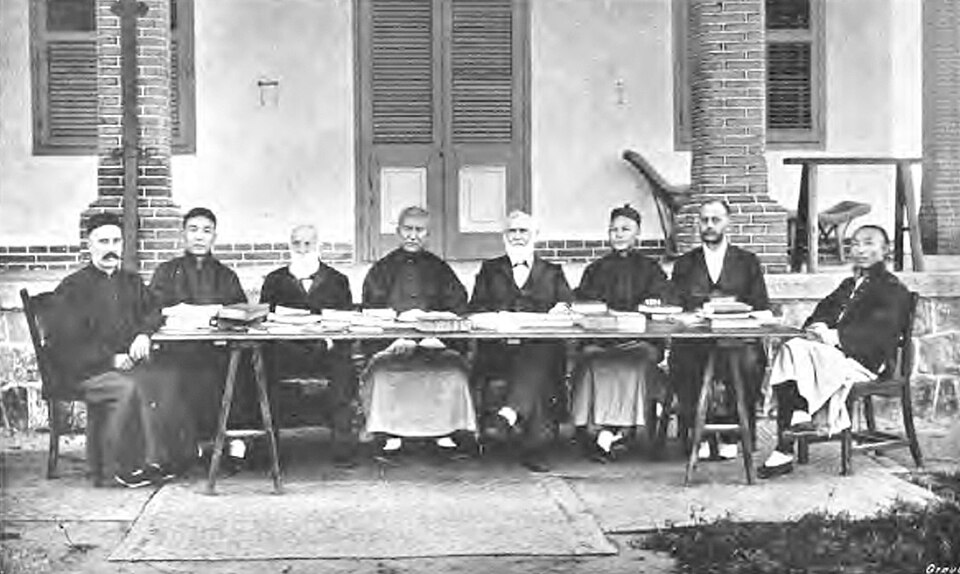
The Chinese Bible revision committee, unknown photographer, about 1906. Image: Wikimedia Commons, public domain Do this: Look at the picture together for a quiet minute before anyone talks.
Read aloud: More than a hundred years ago, missionaries and Chinese scholars worked together for many years to translate the Bible into Mandarin: the Chinese Union Version, finished in 1919, the Bible quoted in this course. They had to listen carefully to every sound and tone, and choose characters that ordinary people could read aloud.
Point and find:
- How many men can you count?
- Who looks like a Chinese scholar, and who looks like a missionary from the West?
- What is on the table?
- Why do you think they had their photograph taken together?
Ask:
- “Why would it matter to get every tone and word right in a Bible translation?”
- “How long do you think it took them?”
Show: Which tone is on mǎ, and what does it mean?
Say this: “The mark ˇ is the third tone.”
Say this: “mǎ is horse (马).”
Answer: Third tone (dipping): horse.
Show: How is 你好 actually said, and why?
Say this: “nǐ and hǎo are both third tones.”
Say this: “Two third tones: the first becomes second.”
Answer: ní hǎo. Still written nǐ hǎo.
Do this: Ask out loud. Let your child try first; help only after a real try.
Ask: Draw the four tone marks and name each tone.
Listen for: ā first (high), á second (rising), ǎ third (dipping), à fourth (falling).
Ask: What does 吗 do at the end of a sentence?
Listen for: It makes it a yes-or-no question.
Ask: Read aloud: bā bá bǎ bà.
Listen for: High, rising, dipping, falling.
2 more on the lesson page.
Read aloud: Make a set of tone cards and practice with hand signs.
Steps:
- Draw one tone mark large on each card: ā á ǎ à.
- Make a hand motion for each: flat, up, dip, down.
- A partner says a syllable (bā, bá, bǎ, bà); hold up the right card.
- Then say the syllables while your partner holds up the card.
Tips for you:
- Exaggerate the tones at first; it helps.
Done when your child can say:
- I can hear all four tones.
- I can say all four tones on any syllable.
Read aloud: Pinyin was made official in the 1950s. Before that, Western scholars used other spellings, which is why older books write Peking for Beijing and Mao Tse-tung for Mao Zedong.
- Saying all syllables with an English sentence melody. Each syllable carries its own tone.
- Putting the tone mark on the wrong letter. It goes on the main vowel: a, o or e first; in iu and ui on the second letter.
Write ā á ǎ à on four paper plates on the floor. A partner says a syllable; toss a beanbag onto the right tone.
Say this: “Tell me what you learned today.”
Listen for: Say and hear the four tones and the light tone.; Read tone marks in pinyin.; Understand that a change of tone changes the meaning.
Let every thing that hath breath praise the LORD. Praise ye the LORD.
Chinese Union Version (和合本): <span class="zh-block" lang="zh-Hans">凡有气息的都要赞美耶和华!你们要赞美耶和华!</span><span class="py-line">Fán yǒu qì xī de dōu yào zàn měi Yēhéhuá! Nǐ men yào zàn měi Yēhéhuá!</span> Every voice, in every language and every tone, is made to praise the Lord.
Spread over the week
3 sessions of 20–30 minutes. Stop while it is still going well.
- Session 1. Warm-up, then read and teach the new idea and the new words. Picture study and show how.
- Session 2. Practice together, then start the project. Finish the project, then the sketchbook.
- Session 3. Narration, the game and the Scripture.