Parent guide · Grade 3 Mandarin · Unit 1
Lesson 1.2 人 口 大 小: The First Picture-Characters
Written for the parent. The Read aloud parts are written to your child; read them as they are. Do this parts are for you. Answers for you are marked Listen for.
At a glance
- Time
- 3 sessions of 20–30 minutes
- Goal
- Read and write 人, 口, 大, 小, 日, 月, 山 and 木. Know that many characters began as pictures. Learn the basic strokes and the first rules of stroke order.
- You need
- Eight index cards
- Pencil, markers
- The 田 grid on the worksheet
- A King James Bible
- Worksheet A · the lesson page (it also has a short video (2:33))
Steps
Do this together: Draw a quick picture of a person, a mouth, a mountain and a tree, using as few lines as you can. Chinese characters started this way more than three thousand years ago.
Read aloud: The big idea. About three thousand years ago, Chinese kings had questions carved on ox bones and turtle shells. These oracle bones show the oldest Chinese writing we have, and many of their little pictures are still the characters people write today.
Read aloud: Eight picture-characters. Look at the table below. 人 is a person walking. 口 is an open mouth. 大 is a person with arms stretched wide: big! 小 is three little dots: small. 日 was a round sun, 月 a crescent moon, 山 three peaks and 木 a tree.
Read aloud: Stroke order. Top before bottom (三), left before right (人: the left stroke first), horizontal before vertical (十), and for a box like 口: left side, then top-and-right in one stroke, then the bottom last to “close the door.”
Do this: Say each word clearly; your child says it back twice. Point to a picture or the real thing when you can.
- 人 (rén) [run (rising)]: person
- 口 (kǒu) [koh (dipping)]: mouth
- 大 (dà) [dah (falling)]: big
- 小 (xiǎo) [shyow (dipping)]: small
- 日 (rì) [rr (falling)]: sun; day
- 月 (yuè) [yweh (falling)]: moon; month
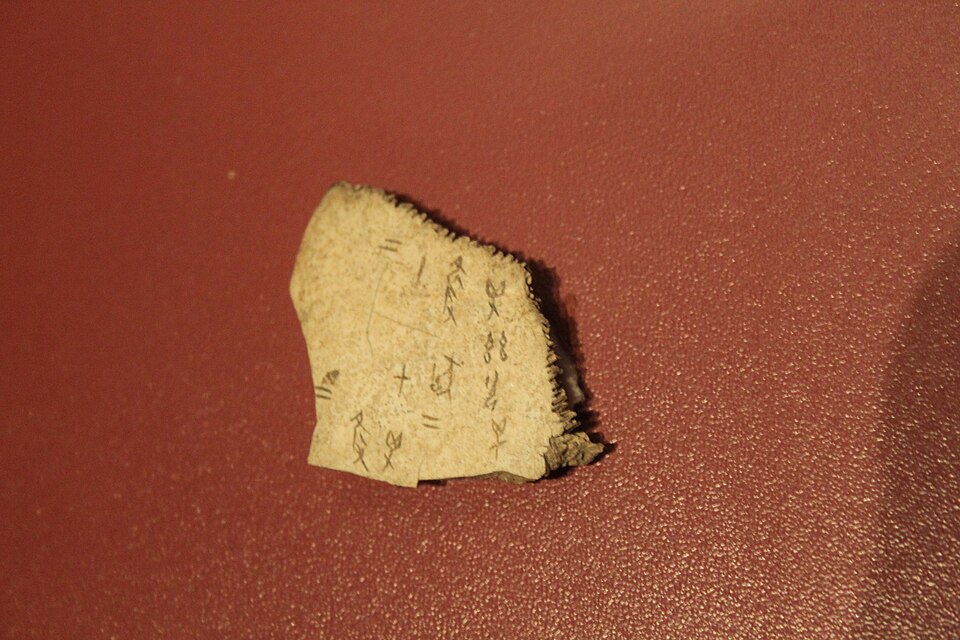
Oracle bone (ox shoulder blade), photograph by Gary Lee Todd, Shang dynasty, about 1200 B.C. Image: Wikimedia Commons, public domain Do this: Look at the picture together for a quiet minute before anyone talks.
Read aloud: About three thousand years ago, the kings of the Shang dynasty had questions carved on bones like this one, about the harvest, the weather and war. The bones were heated until they cracked. Scholars found thousands of these bones near the town of Anyang about a hundred and twenty years ago.
Point and find:
- Find the cracks in the bone.
- Find the rows of little carved marks.
- Do any marks look like pictures?
- What color is the bone?
Ask:
- “Why do you think people wrote on bone instead of paper?”
- “We know God speaks to us through His Word, not through cracks in bones. How is the Bible different from an oracle?”
Show: Which character is a person with arms stretched wide, and what does it mean?
Say this: “A person (人) with a stroke across for the arms.”
Say this: “Stretched wide = big.”
Answer: 大 (dà): big.
Show: In 口, which stroke is written last?
Say this: “Left side, then top-and-right.”
Say this: “The bottom line closes the box.”
Answer: The bottom stroke.
Do this: Ask out loud. Let your child try first; help only after a real try.
Ask: Write 人 and give its meaning.
Listen for: 人, person.
Ask: What is 山?
Listen for: shān, mountain.
Ask: Which two characters began as pictures of the sky?
Listen for: 日 (sun) and 月 (moon).
2 more on the lesson page.
Read aloud: Make picture-to-character cards.
Steps:
- On the front of each card draw the old picture (a person, a mouth…).
- On the back write the character large in a 田 grid, with pinyin and meaning.
- Practice each character three times on the worksheet grid.
- Quiz a partner: show the picture, have them write the character.
Tips for you:
- Say the stroke order out loud as you write.
Done when your child can say:
- I wrote eight characters in the right stroke order.
- I can read them all.
Character Pinyin Meaning Strokes How to remember it 人 rén person 2 a person walking 口 kǒu mouth 3 an open mouth 大 dà big 3 a person with arms stretched wide 小 xiǎo small 3 little dots 日 rì sun; day 4 the sun with a spot 月 yuè moon; month 4 a crescent moon 山 shān mountain 3 three peaks 木 mù tree; wood 4 a tree with branches and roots Read aloud: There are tens of thousands of Chinese characters, but about 3,000 are enough to read most of a newspaper. Simplified characters, used in mainland China and Singapore, have fewer strokes; Taiwan and Hong Kong use traditional characters.
- Writing 人 with the right stroke first. The left-falling stroke comes first.
- Mixing 日 (sun) and 目 (eye). 目 has two lines inside.
One person writes a character in the air with big strokes; the other guesses it. Then write it on the partner’s back with a finger.
Say this: “Tell me what you learned today.”
Listen for: Read and write 人, 口, 大, 小, 日, 月, 山 and 木.; Know that many characters began as pictures.; Learn the basic strokes and the first rules of stroke order.
So God created man in his own image, in the image of God created he him; male and female created he them.
Chinese Union Version (和合本): <span class="zh-block" lang="zh-Hans">神就照着自己的形像造人</span><span class="py-line">Shén jiù zhào zhe zì jǐ de xíng xiàng zào rén</span> God made people, 人, in His own image. Every person is precious to Him.
Spread over the week
3 sessions of 20–30 minutes. Stop while it is still going well.
- Session 1. Warm-up, then read and teach the new idea and the new words. Picture study and show how.
- Session 2. Practice together, then start the project. Finish the project, then the sketchbook.
- Session 3. Narration, the game and the Scripture.