Parent guide · Grade 3 Mandarin · Unit 2
Lesson 2.1 你是哪国人? What Country Are You From?
Written for the parent. The Read aloud parts are written to your child; read them as they are. Do this parts are for you. Answers for you are marked Listen for.
At a glance
- Time
- 3 sessions of 20–30 minutes
- Goal
- Say 我是… (I am…).; Add 人 to a country to name its people: 美国人, 中国人.; Ask 你是哪国人?
- You need
- Paper, markers
- A world map
- A King James Bible
- Worksheet A · the lesson page (it also has a short video (1:58))
Steps
Do this together: On a map or globe, find America, China, England, Canada and Italy. Do you know anyone from another country? Today you learn to say where people are from.
Read aloud: The big idea. 是 links two nouns: 我是学生 (I am a student). To say what country you are from, add 人 (person) to the country: 美国人 (American), 中国人 (Chinese), 英国人 (English), 加拿大人 (Canadian).
Read aloud: Asking. 你是哪国人? (You are which-country person?). The answer puts the country in the same place: 我是美国人.
Read aloud: Names. 美国 means “beautiful country” and 中国 “middle kingdom.” Many country names in Chinese imitate the sound: 意大利 (Yìdàlì) is Italy.
Do this: Say each word clearly; your child says it back twice. Point to a picture or the real thing when you can.
- 是 (shì) [shr (falling)]: to be (am, is, are)
- 美国 (Měiguó) [may-GWOH]: America
- 中国 (Zhōngguó) [jong-GWOH]: China
- 英国 (Yīngguó) [ying-GWOH]: England; Britain
- 国 (guó) [gwoh (rising)]: country
- 学生 (xuésheng) [SHWEH-shung]: student
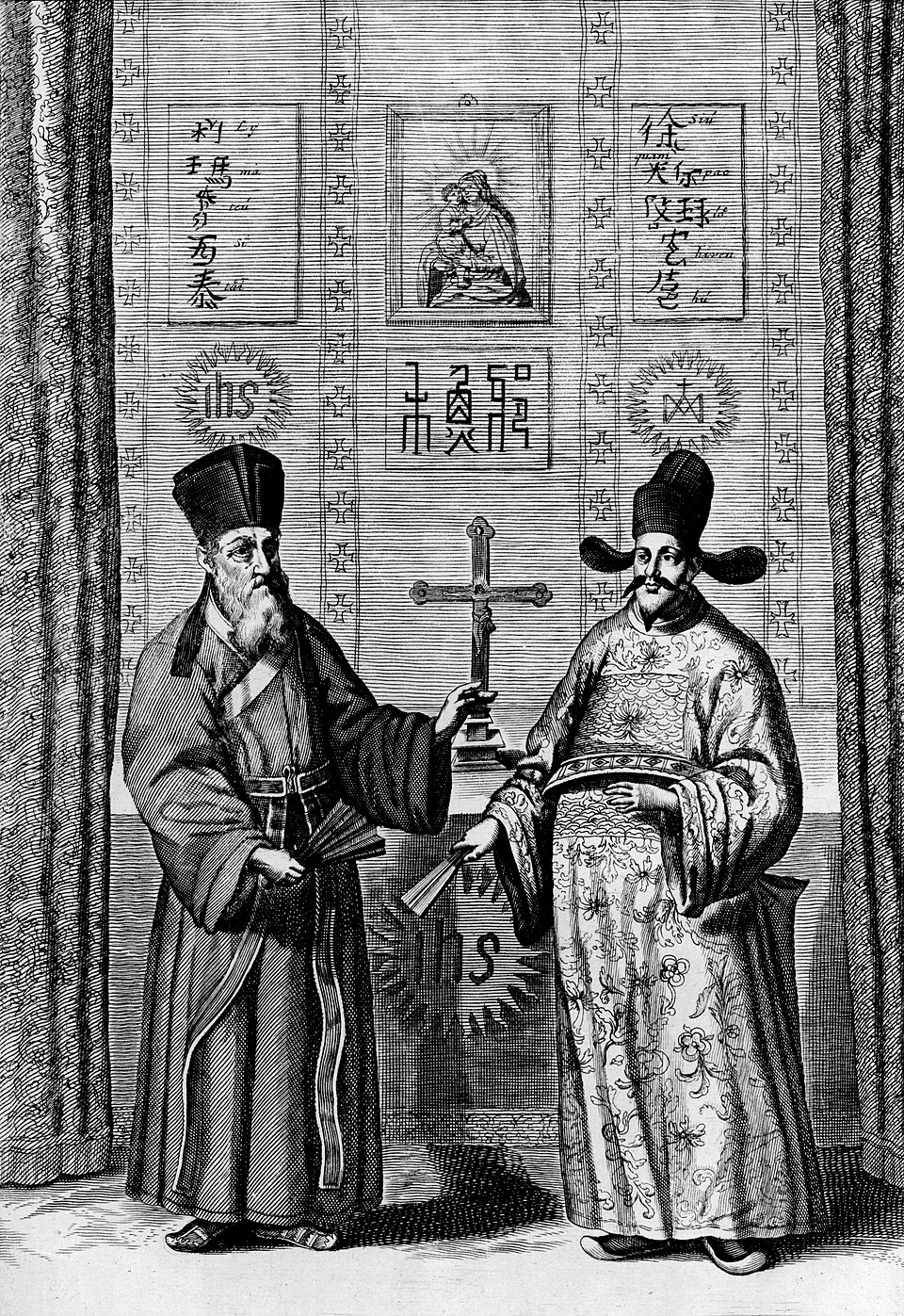
Matteo Ricci and Xu Guangqi, from Athanasius Kircher, China Illustrata, 1667. Image: Wikimedia Commons, public domain Do this: Look at the picture together for a quiet minute before anyone talks.
Read aloud: Matteo Ricci was an Italian missionary who went to China in 1582 and learned to speak and write Chinese so well that scholars admired him. His friend Xu Guangqi was a Chinese scholar and official who became a Christian. Together they translated a famous math book into Chinese.
Point and find:
- Which man is from Italy and which from China? How can you tell?
- What are they wearing?
- Find the cross and the picture of Mary and Jesus.
- Find the Chinese characters on the wall. What do you think they say?
Ask:
- “Why do you think Ricci dressed like a Chinese scholar?”
- “What would it take for you to learn a language as well as Ricci did?”
Show: Say “He is Chinese.”
Say this: “He = 他 (tā).”
Say this: “Chinese person = 中国人.”
Answer: 他是中国人 (tā shì Zhōngguó rén).
Show: Ricci was from Italy. Say “He is Italian.”
Say this: “Italy = 意大利.”
Say this: “Add 人.”
Answer: 他是意大利人 (tā shì Yìdàlì rén).
Do this: Ask out loud. Let your child try first; help only after a real try.
Ask: What does 美国人 mean?
Listen for: American.
Ask: Say “I am a student.”
Listen for: 我是学生.
Ask: Ask what country someone is from.
Listen for: 你是哪国人?
2 more on the lesson page.
Read aloud: Make a chart of countries and their people in Chinese.
Steps:
- Draw five small flags: America, China, England, Canada, Italy.
- Under each, write the country and the people word: 美国 → 美国人.
- Interview family members: 你是哪国人?
- Write their answers on the chart.
Tips for you:
- Say each word aloud with its tones.
Done when your child can say:
- My chart has five countries.
- I asked 你是哪国人 and wrote the answers.
Read aloud: Ricci made the first map of the whole world in Chinese, showing China in the middle so Chinese readers would feel at home. Copies still survive.
- Using 是 with adjectives: 我是高 is wrong. 是 links nouns (我是学生); adjectives use 很 (我很高).
- Forgetting 人: 我是美国 means “I am America.”
Make paper passports. Each player picks a country. Others ask 你是哪国人? and stamp the passport when the answer is correct.
Say this: “Tell me what you learned today.”
Listen for: Say 我是… (I am…).; Add 人 to a country to name its people: 美国人, 中国人.; Ask 你是哪国人?
After this I beheld, and, lo, a great multitude, which no man could number, of all nations, and kindreds, and people, and tongues, stood before the throne, and before the Lamb, clothed with white robes, and palms in their hands;
Chinese Union Version (和合本): <span class="zh-block" lang="zh-Hans">是从各国、各族、各民、各方来的</span><span class="py-line">Shì cóng gè guó, gè zú, gè mín, gè fāng lái de</span> In heaven there will be people from every nation, tribe and language, worshipping the Lamb together.
Spread over the week
3 sessions of 20–30 minutes. Stop while it is still going well.
- Session 1. Warm-up, then read and teach the new idea and the new words. Picture study and show how.
- Session 2. Practice together, then start the project. Finish the project, then the sketchbook.
- Session 3. Narration, the game and the Scripture.