Parent guide · Grade 3 Mandarin · Unit 5
Lesson 5.1 我喜欢吃…: What I Like to Eat
Written for the parent. The Read aloud parts are written to your child; read them as they are. Do this parts are for you. Answers for you are marked Listen for.
At a glance
- Time
- 3 sessions of 20–30 minutes
- Goal
- Say 我喜欢吃… / 我不喜欢吃….; Use 吃 (eat) and 喝 (drink).; Ask 你喜欢吃什么?
- You need
- A chart with food pictures down the side and names across the top
- A King James Bible
- Worksheet A · the lesson page (it also has a short video (2:45))
Steps
Do this together: Make two lists: foods you love and foods you don’t. Today you learn to tell them in Chinese, politely!
Read aloud: The big idea. 我喜欢吃面条 (I like to eat noodles). 我不喜欢喝茶 (I don’t like to drink tea). 喜欢 + verb + food.
Read aloud: Asking what. Put 什么 where the answer goes: 你喜欢吃什么? → 我喜欢吃饺子.
Read aloud: Food words. 米饭 (rice), 面条 (noodles), 饺子 (dumplings), 鸡肉 (chicken), 鱼 (fish), 菜 (vegetables), 水果 (fruit), 茶 (tea), 果汁 (juice).
Do this: Say each word clearly; your child says it back twice. Point to a picture or the real thing when you can.
- 喜欢 (xǐhuan) [SHEE-hwahn]: to like
- 吃 (chī) [chr (high)]: to eat
- 喝 (hē) [huh (high)]: to drink
- 什么 (shénme) [SHUN-muh]: what
- 菜 (cài) [tsai (falling)]: vegetable; dish
- 茶 (chá) [chah (rising)]: tea
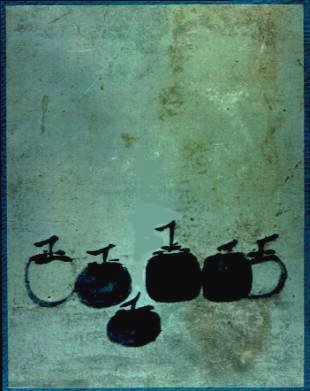
Six Persimmons, Muqi, 13th century (Southern Song dynasty). Image: Wikimedia Commons, public domain Do this: Look at the picture together for a quiet minute before anyone talks.
Read aloud: Muqi was a Chinese painter about eight hundred years ago. With just six brushstrokes of ink for six fruits, some light and some dark, he made one of the most famous still-life paintings in East Asia. Persimmons are sweet orange fruits that ripen in autumn.
Point and find:
- Count the persimmons in Chinese with a measure word: 六个柿子.
- Which one is the darkest? The lightest?
- How many strokes do you think each one took?
- Where is the one fruit that is out of the row?
Ask:
- “How can black ink show an orange fruit?”
- “What fruit would you paint, and do you like to eat it? (我喜欢吃…)”
Show: Say “I like to drink juice.”
Say this: “Drink = 喝.”
Say this: “Juice = 果汁.”
Answer: 我喜欢喝果汁.
Show: Ask your friend what she likes to drink.
Say this: “什么 goes where the answer goes.”
Answer: 你喜欢喝什么?
Do this: Ask out loud. Let your child try first; help only after a real try.
Ask: What does 吃 mean?
Listen for: To eat.
Ask: Say “I like fish.”
Listen for: 我喜欢吃鱼.
Ask: Say “I don’t like vegetables.”
Listen for: 我不喜欢吃菜.
2 more on the lesson page.
Read aloud: Take a food poll of your family.
Steps:
- Ask each person: 你喜欢吃饺子吗? 你喜欢喝茶吗?
- Mark 喜欢 with a smile and 不喜欢 with a frown.
- Count the smiles for each food in Chinese.
- Report: 三个人喜欢吃饺子.
Tips for you:
- Use 吃 for food and 喝 for drinks.
Done when your child can say:
- I asked about six foods.
- I reported the results in Chinese.
Read aloud: Tea was first drunk in China thousands of years ago. Chinese tea spread to Japan, to Europe and to America, and the word “tea” itself comes from the way people say 茶 in southern China (te).
- Using 吃 for drinks. Drinks use 喝.
- Putting 什么 at the start: 什么你喜欢吃? Keep the same order as the answer.
Hold up food pictures. The child answers 喜欢! or 不喜欢! with a full sentence before the next card comes.
Say this: “Tell me what you learned today.”
Listen for: Say 我喜欢吃… / 我不喜欢吃….; Use 吃 (eat) and 喝 (drink).; Ask 你喜欢吃什么?
O taste and see that the LORD is good: blessed is the man that trusteth in him.
Chinese Union Version (和合本): <span class="zh-block" lang="zh-Hans">你们要尝尝主恩的滋味,便知道他是美善</span><span class="py-line">Nǐ men yào cháng cháng zhǔ ēn de zī wèi, biàn zhī dào tā shì měi shàn</span> We taste food to know if it is good. David says: taste and see that the Lord is good.
Spread over the week
3 sessions of 20–30 minutes. Stop while it is still going well.
- Session 1. Warm-up, then read and teach the new idea and the new words. Picture study and show how.
- Session 2. Practice together, then start the project. Finish the project, then the sketchbook.
- Session 3. Narration, the game and the Scripture.