Parent guide · Grade 1 Russian · Unit 4
Lesson 4.1 Хлеб, молоко́, вода́, чай
Written for the parent. The Read aloud parts are written to your child; read them as they are. Do this parts are for you. Answers for you are marked Listen for.
At a glance
- Time
- 3 sessions of 15–20 minutes
- Goal
- Name bread, milk, water and tea in Russian. Point at food and say Э́то хлеб. Find food in a Russian painting.
- You need
- A simple bread or roll recipe
- Flour, water, yeast, salt (and milk if the recipe uses it)
- A grown-up in the kitchen
- A sketchbook or plain paper, and crayons
- A King James Bible
- Worksheet A · the lesson page (it also has a short video (2:04))
Steps
Do this together: What did you eat for breakfast? What did you drink? Today you learn bread, milk, water and tea in Russian.
Read aloud: The story. The painter Boris Kustodiev loved the bright colors of old Russian towns. In this painting a woman sits at a table outdoors, having tea. Beside her is a samovar, a tall shining metal pot that keeps water hot for tea. The table is full: a big watermelon, apples, grapes and a basket of sweet bread. A cat rubs against her shoulder, hoping for a treat, and behind her are the white churches of the town.
Read aloud: How Russian sounds. Хлеб is khlyep, with a breathy kh at the start. Молоко́ is muh-lah-KOH, loud at the end. Вода́ is vah-DAH. Чай is chai, like the English word for spiced tea.
Read aloud: Say it and move. Break a pretend loaf: хлеб! Pretend to milk a cow: молоко́! Drink a big glass: вода́! Blow on a hot cup: чай!
Do this: Say each word clearly; your child says it back twice. Point to a picture or the real thing when you can.
- хлеб [khlyehp]: bread
- молоко́ [muh-lah-KOH]: milk
- вода́ [vah-DAH]: water
- чай [chahy]: tea
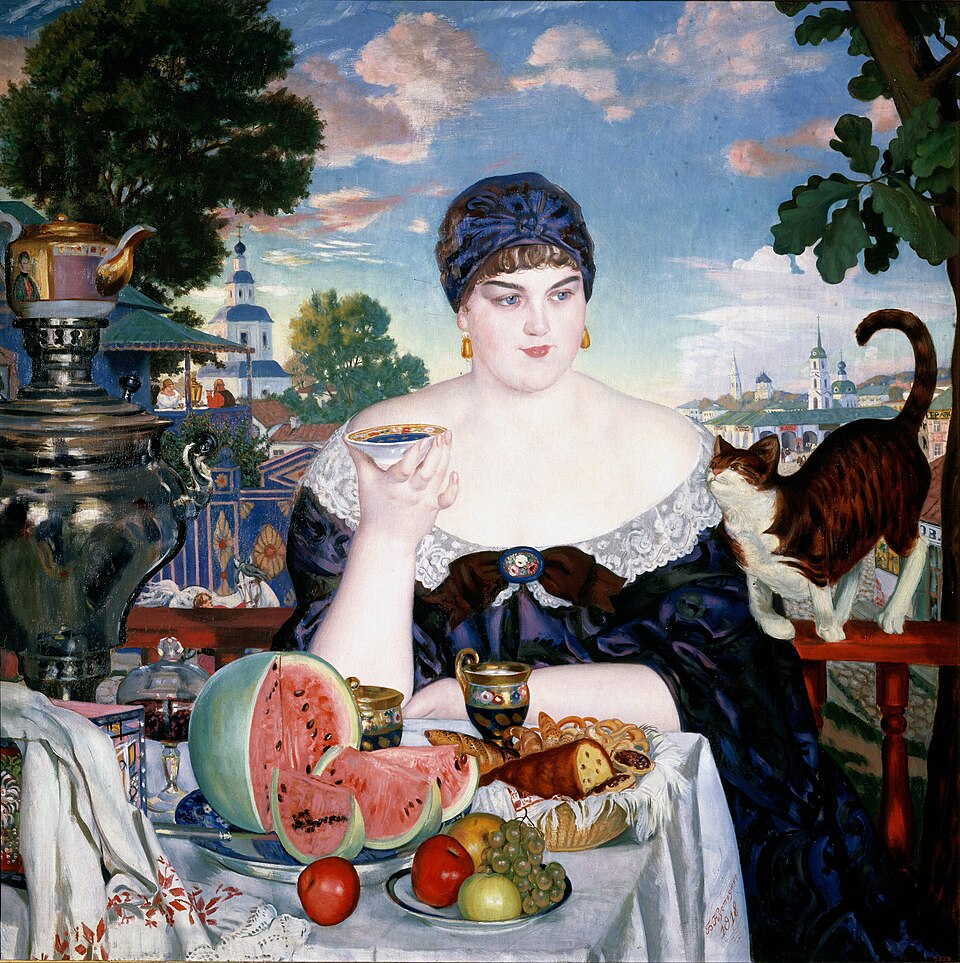
Merchant’s Wife at Tea, Boris Kustodiev, 1918. Image: Wikimedia Commons, public domain Do this: Look at the picture together for a quiet minute before anyone talks.
Read aloud: In old Russia, families drank tea from a saucer, the way she does here. Kustodiev filled the picture with things to find. How many foods can you see?
Point and find:
- Find the samovar. What is it for?
- Find the watermelon. What color is it inside?
- What is the cat doing?
- What is she drinking?
Ask:
- “What would you like to eat from this table?”
- “Who makes the meals at your house? How can you thank them?”
Show: You are thirsty. What do you ask for in Russian?
Say this: “When you are thirsty, you drink water.”
Say this: “Water is вода́.”
Answer: Вода́, пожа́луйста!
Show: Point to a loaf and say “This is bread.”
Say this: “This is: э́то.”
Say this: “Bread: хлеб.”
Answer: Э́то хлеб.
Do this: Ask out loud. Let your child try first; help only after a real try.
Ask: Say bread in Russian.
Listen for: Хлеб.
Ask: Say milk in Russian.
Listen for: Молоко́.
Ask: Say water in Russian.
Listen for: Вода́.
3 more on the lesson page.
Read aloud: Help a parent bake simple bread or rolls, and name each ingredient in Russian.
Steps:
- Before you start, point to the water and milk and say вода́ and молоко́.
- Help measure and stir.
- When the bread is baked, say: Э́то хлеб!
- Share it with your family with a cup of tea: чай!
Tips for you:
- If you cannot bake, make a play bread with play dough and name it.
Done when your child can say:
- I helped make bread.
- I can name bread, milk, water and tea in Russian.
Do this: Your child picks one or more; you write the date.
- Draw bread, a glass of milk, a glass of water and a cup of tea in your picture dictionary. A parent writes хлеб, молоко́, вода́ and чай.
Read aloud: Bread is so important in Russia that guests are welcomed with a big round loaf called a карава́й, with a little dish of salt on top. The guest breaks off a piece, dips it in the salt, and eats it.
- Saying moh-loh-koh with every o round. Only the last o is round: muh-lah-KOH.
- Saying the х in хлеб like an English h. Make it breathy, from the back of the throat: khlyep.
Put a slice of bread, a cup and a tea bag in a bag. The child reaches in, feels one, and guesses in Russian before pulling it out.
Say this: “Tell me what you learned today.”
Listen for: Name bread, milk, water and tea in Russian.; Point at food and say Э́то хлеб.; Find food in a Russian painting.
Give us this day our daily bread.
In the Russian Bible (Synodal translation), this verse reads: <i class="ru-bible" lang="ru">хлеб наш насущный дай нам на сей день</i> Jesus taught us to ask our Father in heaven for our daily bread. Every meal is a gift from God.
Spread over the week
3 sessions of 15–20 minutes. Stop while it is still going well.
- Session 1. Warm-up, then read and teach the new idea and the new words. Picture study and show how.
- Session 2. Practice together, then start the project. Finish the project, then the sketchbook.
- Session 3. Narration, the game and the Scripture.