Parent guide · Grade 1 Russian · Unit 5
Lesson 5.1 Ша́пка, шарф, ва́режки, сапоги́
Written for the parent. The Read aloud parts are written to your child; read them as they are. Do this parts are for you. Answers for you are marked Listen for.
At a glance
- Time
- 3 sessions of 15–20 minutes
- Goal
- Name hat, scarf, mittens and boots in Russian. Get dressed for the cold, naming each thing. Look at a painting of a winter game.
- You need
- Paper or cardstock
- Crayons
- Safety scissors (with a parent)
- Tape
- A sketchbook or plain paper, and crayons
- A King James Bible
- Worksheet A · the lesson page (it also has a short video (37:07))
Steps
Do this together: Pretend it is very cold. What do you put on before you go out in the snow? Today you learn winter clothes in Russian.
Read aloud: The story. Vasily Surikov grew up in Siberia, where the winters are long and very cold. When he was a boy, the people of his town played a wild winter game. They built a snow fort with walls of ice, and one rider on a horse had to break through the wall while the others threw snowballs and waved branches to stop him. In this painting the horse leaps through the snow wall, and everyone, bundled in fur hats and warm coats, is laughing and shouting.
Read aloud: How Russian sounds. Ша́пка is SHAHP-kuh. Шарф is shahrf. Ва́режки is VAH-reesh-kee. Сапоги́ is suh-pah-GEE, loud at the end.
Read aloud: Say it and move. Pull on a hat: ша́пка! Wrap a scarf: шарф! Clap your mittens: ва́режки! Stomp your boots: сапоги́!
Do this: Say each word clearly; your child says it back twice. Point to a picture or the real thing when you can.
- ша́пка [SHAHP-kuh]: hat, warm cap
- шарф [shahrf]: scarf
- ва́режки [VAH-reesh-kee]: mittens
- сапоги́ [suh-pah-GEE]: boots
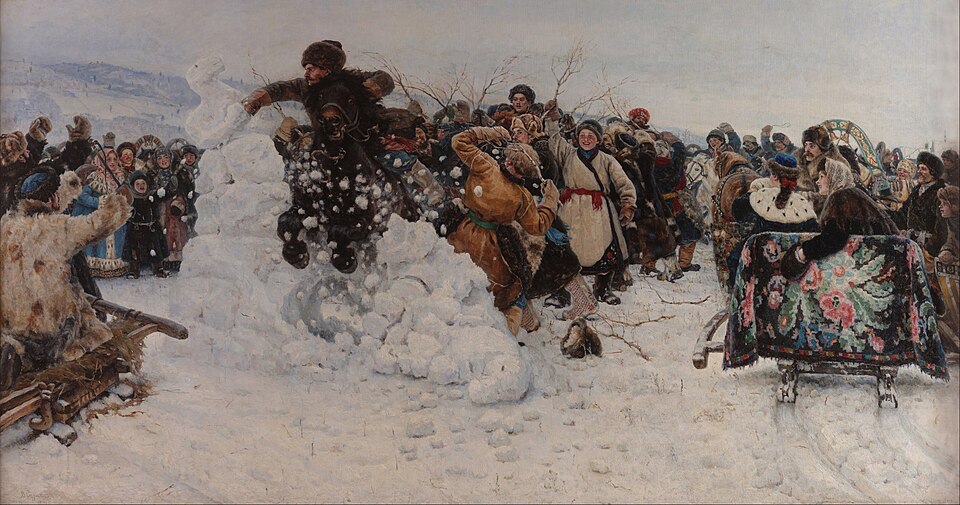
Taking the Snow Town, Vasily Surikov, 1891. Image: Wikimedia Commons, public domain Do this: Look at the picture together for a quiet minute before anyone talks.
Read aloud: Surikov painted his own family and neighbors in this picture. The game was played at the end of winter, before Lent. Look at all the warm clothes!
Point and find:
- Find the horse. What is it doing?
- Find someone in a fur hat. Say ша́пка.
- Is it warm or cold? How do you know?
- Find the sleigh.
Ask:
- “What do you like to play in the snow?”
- “What do you wear when it is cold?”
Show: Your hands are cold. What do you put on? Say it in Russian.
Say this: “You put mittens on your hands.”
Say this: “Mittens are ва́режки.”
Answer: Ва́режки.
Show: Your feet need to stay dry in the snow. What do you wear?
Say this: “You wear boots.”
Say this: “Boots are сапоги́.”
Answer: Сапоги́.
Do this: Ask out loud. Let your child try first; help only after a real try.
Ask: Say hat in Russian.
Listen for: Ша́пка.
Ask: Say scarf in Russian.
Listen for: Шарф.
Ask: Say mittens in Russian.
Listen for: Ва́режки.
2 more on the lesson page.
Read aloud: Make a paper doll and dress it in winter clothes, naming each one in Russian.
Steps:
- Draw and cut out a simple paper doll.
- Draw and cut out a hat, a scarf, mittens and boots that fit it.
- Dress the doll one piece at a time, saying ша́пка, шарф, ва́режки, сапоги́.
- Then dress yourself the same way before going outside!
Tips for you:
- Make the clothes in your favorite colors and name the colors too.
Done when your child can say:
- My doll has four winter clothes.
- I can name each one in Russian.
Do this: Your child picks one or more; you write the date.
- Draw a hat, a scarf, mittens and boots in your picture dictionary. A parent writes ша́пка, шарф, ва́режки and сапоги́.
Read aloud: Russian winters can be so cold that children wear ва́ленки, thick boots made of pressed wool felt. They are warm and soft, and in the old days a whole family might share a few pairs.
- Saying SAH-po-gee. The loud part is at the end: suh-pah-GEE.
- Saying VAH-rezh-kee with a zh. Before к the ж sounds like sh: VAH-reesh-kee.
Put a hat, a scarf, mittens and boots in a pile. A parent calls a word in Russian, and the child runs to put it on. When everything is on, the child shouts Хо́лодно! and takes it all off again.
Say this: “Tell me what you learned today.”
Listen for: Name hat, scarf, mittens and boots in Russian.; Get dressed for the cold, naming each thing.; Look at a painting of a winter game.
He giveth snow like wool: he scattereth the hoarfrost like ashes.
In the Russian Bible (Synodal translation), this verse reads: <i class="ru-bible" lang="ru">дает снег, как волну</i> (Psalm 147:5 in the Russian numbering) God sends the snow like soft white wool. The cold and the snow are His, and He takes care of us in every season.
Spread over the week
3 sessions of 15–20 minutes. Stop while it is still going well.
- Session 1. Warm-up, then read and teach the new idea and the new words. Picture study and show how.
- Session 2. Practice together, then start the project. Finish the project, then the sketchbook.
- Session 3. Narration, the game and the Scripture.