Parent guide · Grade 2 Russian · Unit 2
Lesson 2.1 Кни́га, ру́чка, каранда́ш, тетра́дь
Written for the parent. The Read aloud parts are written to your child; read them as they are. Do this parts are for you. Answers for you are marked Listen for.
At a glance
- Time
- 3 sessions of 15–20 minutes
- Goal
- Name book, pen, pencil and notebook in Russian. Read the letters you know in these words. Look closely at a painting of a boy who wanted to learn.
- You need
- A shoebox or pencil box
- Paper, crayons, glue
- A book, a pen, a pencil and a notebook
- A sketchbook or plain paper, and crayons
- A King James Bible
- Worksheet A · the lesson page (it also has a short video (3:08))
Steps
Do this together: Put a book, a pen, a pencil and a notebook on the table. Which one do you use most? Today you learn their names in Russian.
Read aloud: The story. Nikolai Bogdanov-Belsky was born in a poor village family and worked as a little shepherd boy. A kind teacher named Sergei Rachinsky saw how much he loved to draw and took him into his village school, where he learned to read, to write and to paint. When he grew up he painted this picture of a poor boy in ragged clothes, with a stick and a beggar’s bag, standing at the school door. He never forgot what it was like to want to learn.
Read aloud: How Russian sounds. Кни́га is KNEE-guh: say the k! Ру́чка is ROOCH-kuh. Каранда́ш is kuh-rahn-DAHSH, loud at the end. Тетра́дь is tee-TRAHT’. Look at кни́га: you can already read К, А and Н!
Read aloud: Say it and move. Open your hands like a book: кни́га! Write in the air: ру́чка! Sharpen a pretend pencil: каранда́ш! Turn the pages of a notebook: тетра́дь!
Do this: Say each word clearly; your child says it back twice. Point to a picture or the real thing when you can.
- кни́га (kniga) [KNEE-guh]: book
- ру́чка (ruchka) [ROOCH-kuh]: pen
- каранда́ш (karandash) [kuh-rahn-DAHSH]: pencil
- тетра́дь (tetrad) [teet-RAHT]: notebook
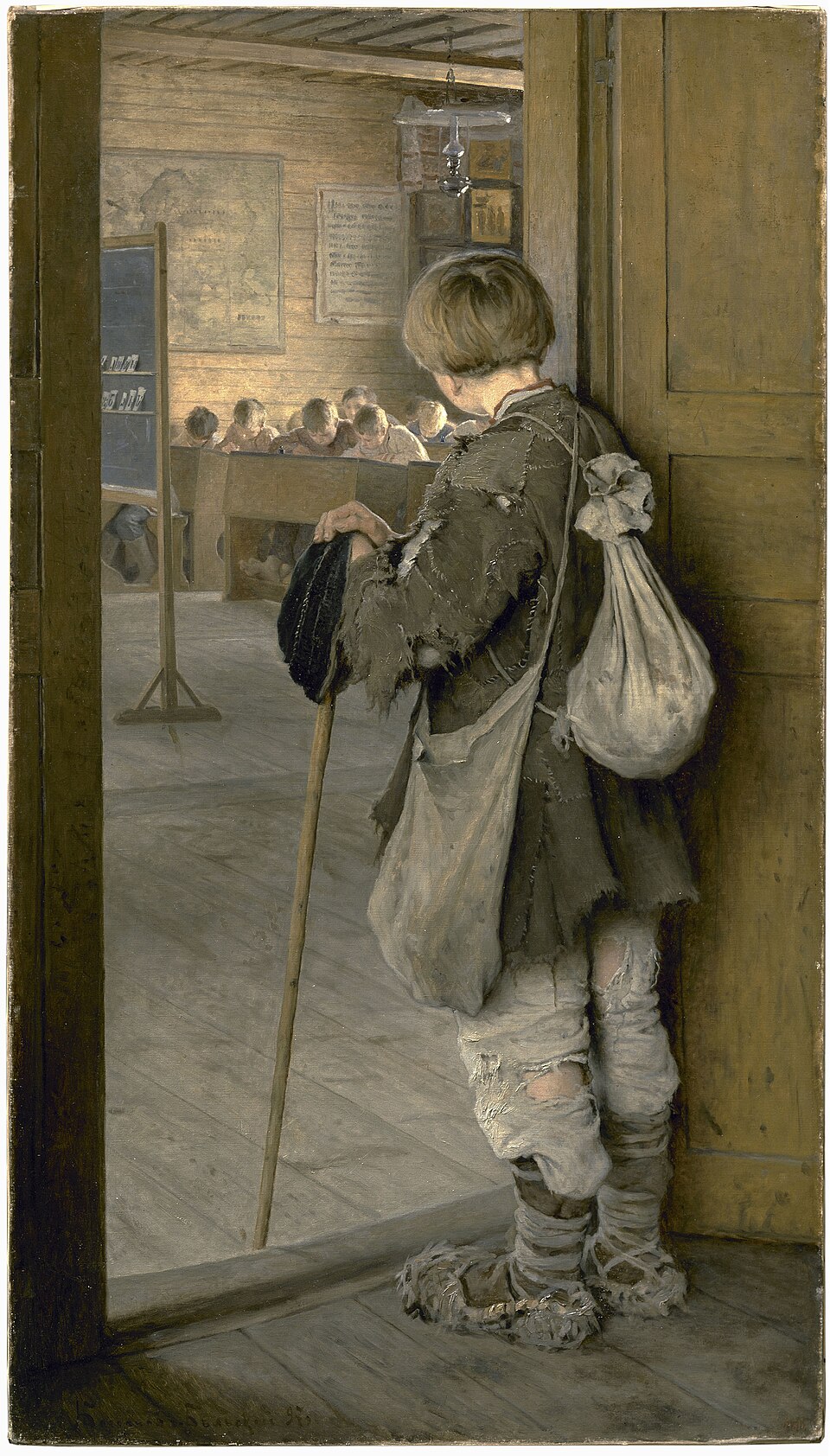
At the School Door, Nikolai Bogdanov-Belsky, 1897. Image: Wikimedia Commons, public domain Do this: Look at the picture together for a quiet minute before anyone talks.
Read aloud: We see only the boy’s back. We cannot see his face, but we can tell how much he wants to go in. Bogdanov-Belsky never forgot what it felt like to stand at that door.
Point and find:
- What is the boy carrying?
- Are his clothes new or old?
- What does he see through the door?
- How do you think he feels?
Ask:
- “Why is it a gift to be able to go to school or learn at home?”
- “How could you help someone who wants to learn?”
Show: You need to write a word. What do you pick up? Say two answers in Russian.
Say this: “You write with a pen or a pencil.”
Say this: “Pen is ру́чка , pencil is каранда́ш.”
Answer: Ру́чка или каранда́ш.
Show: Which letters in кни́га can you already read?
Say this: “You know К, Н and А.”
Say this: “И and Г are new.”
Answer: К, Н, А.
Do this: Ask out loud. Let your child try first; help only after a real try.
Ask: Say book in Russian.
Listen for: Кни́га.
Ask: Say pen in Russian.
Listen for: Ру́чка.
Ask: Say pencil in Russian.
Listen for: Каранда́ш.
2 more on the lesson page.
Read aloud: Decorate a box to hold your school things, with Russian labels.
Steps:
- Decorate the box.
- A parent writes кни́га, ру́чка, каранда́ш and тетра́дь on little labels.
- Glue a label on each thing (or on the box where it goes).
- Pack the box, naming each thing in Russian.
Tips for you:
- Copy one label yourself in big letters.
Done when your child can say:
- My box holds four school things.
- I can name each one in Russian.
Do this: Your child picks one or more; you write the date.
- In your notebook, draw a book, a pen, a pencil and a notebook. A parent writes the Russian words; trace them.
Read aloud: In Russia, the first day of school is September 1. Children bring flowers to their teachers, and the youngest pupils ring a little bell to start the school year.
- Saying nee-ga without the k. In Russian you say the k: KNEE-guh.
- Saying ka-RAN-dash. The loud part is at the end: kuh-rahn-DAHSH.
A parent says a school word in Russian. The child finds it and puts it in a backpack. Then the child unpacks, naming each thing.
Say this: “Tell me what you learned today.”
Listen for: Name book, pen, pencil and notebook in Russian.; Read the letters you know in these words.; Look closely at a painting of a boy who wanted to learn.
A wise man will hear, and will increase learning; and a man of understanding shall attain unto wise counsels:
In the Russian Bible (Synodal translation), this verse reads: <i class="ru-bible" lang="ru">послушает мудрый — и умножит познания</i> A wise person keeps listening and keeps learning. Every school day is a chance to grow wiser.
Spread over the week
3 sessions of 15–20 minutes. Stop while it is still going well.
- Session 1. Warm-up, then read and teach the new idea and the new words. Picture study and show how.
- Session 2. Practice together, then start the project. Finish the project, then the sketchbook.
- Session 3. Narration, the game and the Scripture.