Parent guide · Grade 2 Russian · Unit 3
Lesson 3.1 Дека́брь, янва́рь, февра́ль
Written for the parent. The Read aloud parts are written to your child; read them as they are. Do this parts are for you. Answers for you are marked Listen for.
At a glance
- Time
- 3 sessions of 15–20 minutes
- Goal
- Name December, January and February in Russian. Say ме́сяц (month) and год (year). Look closely at a winter forest painting.
- You need
- Dark blue or black paper
- White crayon, chalk or paint
- Brown crayon
- Cotton balls (optional)
- A sketchbook or plain paper, and crayons
- A King James Bible
- Worksheet A · the lesson page (it also has a short video (2:20))
Steps
Do this together: Which months are cold where you live? Today you learn the names of the winter months in Russian.
Read aloud: The story. Ivan Shishkin loved the deep forests of Russia, especially the tall pines. He walked in them in every season, and he knew each kind of tree. In this painting it is the middle of winter. Fresh snow lies thick on the ground and on the branches, and everything is quiet. The sunlight comes through the trees and the shadows on the snow are blue. You can almost feel the cold, still air.
Read aloud: How Russian sounds. The winter months sound a lot like English: дека́брь (dee-KAHBR’), янва́рь (yeen-VAHR’), февра́ль (feev-RAHL’). All three are loud at the end. Ме́сяц means month, and год means year: goht.
Read aloud: Say it and move. Shiver: дека́брь! Shiver harder: янва́рь! Shiver and stamp your feet: февра́ль! Spin around once for a whole year: год!
Do this: Say each word clearly; your child says it back twice. Point to a picture or the real thing when you can.
- дека́брь [dee-KAHBR]: December
- янва́рь [yeen-VAHR]: January
- февра́ль [feev-RAHL]: February
- ме́сяц [MYEH-suhts]: month
- год [goht]: year
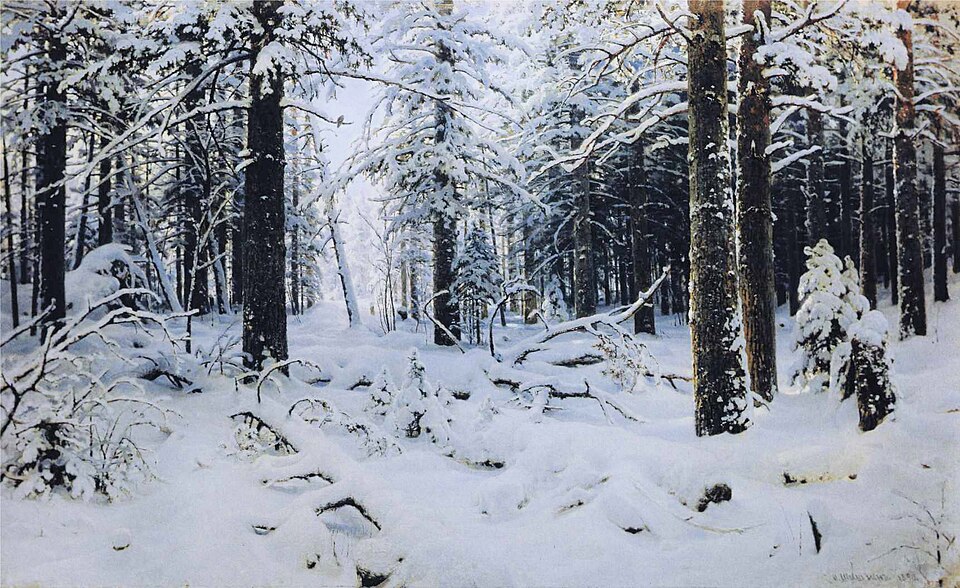
Winter, Ivan Shishkin, 1890. Image: Wikimedia Commons, public domain Do this: Look at the picture together for a quiet minute before anyone talks.
Read aloud: There are no people and no animals in this picture, only the trees, the snow and the light. Shishkin wanted us to stand still and listen to the silence of the winter forest.
Point and find:
- What color are the shadows on the snow?
- Where is the light coming from?
- Can you find a little tree under the snow?
- Is it windy or still?
Ask:
- “What do you hear when you walk in the snow?”
- “What is your favorite thing about winter?”
Show: What month comes after December? Say it in Russian.
Say this: “After December comes January.”
Say this: “January is янва́рь.”
Answer: Янва́рь.
Show: How many months are in a year? Say month and year in Russian.
Say this: “A year has twelve months.”
Say this: “Month is ме́сяц , year is год.”
Answer: Twelve: ме́сяц, год.
Do this: Ask out loud. Let your child try first; help only after a real try.
Ask: Say December in Russian.
Listen for: Дека́брь.
Ask: Say January in Russian.
Listen for: Янва́рь.
Ask: Say February in Russian.
Listen for: Февра́ль.
2 more on the lesson page.
Read aloud: Make your own winter forest like Shishkin’s.
Steps:
- Draw tall tree trunks with brown crayon.
- Add snow on the branches and the ground with white.
- Add blue shadows on the snow.
- Write the three winter months at the bottom: дека́брь, янва́рь, февра́ль.
Tips for you:
- Glue on cotton balls for extra snow.
Done when your child can say:
- My picture shows a winter forest.
- I wrote or traced the winter months.
Do this: Your child picks one or more; you write the date.
- In your notebook, write the three winter months with a parent’s help, and draw a snowflake next to each.
Read aloud: In much of Russia, January is the coldest month. In Siberia it can be colder than forty degrees below zero, so cold that your breath crackles in the air.
- Saying DE-kabr. All three winter months are loud at the end: dee-KAHBR’.
- Saying a hard r and l at the end. The ь makes them soft.
Write дека́брь, янва́рь and февра́ль on cards. Mix them up. The child puts them in order and reads them. Then add ме́сяц and год cards and act each one out.
Say this: “Tell me what you learned today.”
Listen for: Name December, January and February in Russian.; Say ме́сяц (month) and год (year).; Look closely at a winter forest painting.
And God said, Let there be lights in the firmament of the heaven to divide the day from the night; and let them be for signs, and for seasons, and for days, and years:
In the Russian Bible (Synodal translation), this verse reads: <i class="ru-bible" lang="ru">для знамений, и времен, и дней, и годов</i> God made the sun and the moon to mark the days, the months and the years. The calendar is part of His good creation.
Spread over the week
3 sessions of 15–20 minutes. Stop while it is still going well.
- Session 1. Warm-up, then read and teach the new idea and the new words. Picture study and show how.
- Session 2. Practice together, then start the project. Finish the project, then the sketchbook.
- Session 3. Narration, the game and the Scripture.