Parent guide · Grade 1 Spanish · Unit 1
Lesson 1.1 Mamá, Papá and Me
Written for the parent. The Read aloud parts are written to your child; read them as they are. Do this parts are for you. Answers for you are marked Listen for.
At a glance
- Time
- 3 sessions of 15–20 minutes
- Goal
- Name the family in Spanish: la familia, mamá, papá, el hermano, la hermana, el bebé. Say Te quiero (I love you). Know that God gave us families and tells us to honor our parents.
- You need
- Paper or card stock
- Crayons or markers
- Tape and scissors (with a parent's help)
- A sketchbook or plain paper, and crayons
- A King James Bible
- Worksheet A · the lesson page (it also has a short video (3:07))
Steps
Do this together: Look at a family photo together. Point to each person and say who they are. Today you learn to say who they are in Spanish, and to tell them you love them.
Read aloud: The story. About one hundred and thirty years ago in Sweden there lived a painter named Carl Larsson, his wife Karin and their eight children. They lived in a little red house in the country, which they filled with flowers, bright painted furniture and laughter. Carl painted his family again and again: the children reading, sewing, playing and helping. In one picture, the whole family eats breakfast outside on a summer morning, at a long table set under a big white birch tree. You can see the children from behind, sitting on the bench, and their mother at the end of the table. A little dog sits by the table, hoping for a crumb! Carl did not paint kings or battles; he painted the family God gave him, because to him that was the most beautiful thing in the world.
Read aloud: How Spanish sounds. In mamá and papá, the accent mark means: lean on the end of the word, mah-MAH, pah-PAH. Without the accent, papa means potato! In hermano and hermana, the h is quiet: ehr-MAH-noh. One letter changes the word: hermano (o) is a brother, hermana (a) is a sister.
Read aloud: Say it and move. Point to each person in a photo (or in the room) and say who they are: mamá, papá, mi hermano, mi hermana, el bebé. Rock your arms for el bebé. Then hug someone and say Te quiero.
Do this: Say each word clearly; your child says it back twice. Point to a picture or the real thing when you can.
- la familia [lah fah-MEE-lyah]: the family
- mamá [mah-MAH]: mom
- papá [pah-PAH]: dad
- el hermano [ehl ehr-MAH-noh]: the brother
- la hermana [lah ehr-MAH-nah]: the sister
- el bebé [ehl beh-BEH]: the baby
- te quiero [teh KYEH-roh]: I love you
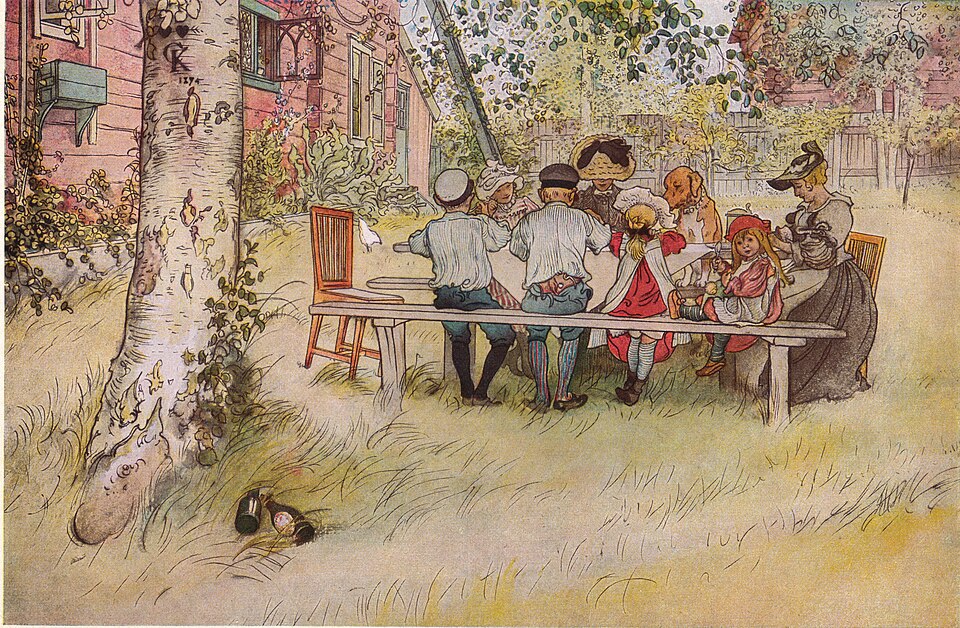
Breakfast under the Big Birch, Carl Larsson, 1896. Image: Wikimedia Commons, public domain Do this: Look at the picture together for a quiet minute before anyone talks.
Read aloud: Carl Larsson painted this watercolor in the garden of his family's home in the Swedish village of Sundborn. It was one of a set of pictures of his home and family that he later printed in a book, so that other families could see how happy a simple home can be.
Point and find:
- Find the big white tree. What is underneath it?
- Count the people at the table in Spanish.
- Find the little dog. What do you think it wants?
- What colors are the chairs? Say it in Spanish.
Ask:
- “Why do you think Carl Larsson loved painting his family?”
- “What is your favorite meal to eat with your family?”
Show: How do you introduce your mother in Spanish?
Say this: “Mother is mamá (or la madre).”
Say this: “For a woman or girl we say Esta es (this is).”
Say this: “My is mi.”
Answer: Esta es mi mamá.
Show: Your brother is named Luke. How do you introduce him?
Say this: “Brother is hermano.”
Say this: “For a boy we say Este es.”
Answer: Este es mi hermano, Luke.
Do this: Ask out loud. Let your child try first; help only after a real try.
Ask: What does la familia mean?
Listen for: The family.
Ask: What is el hermano?
Listen for: The brother.
Ask: How do you say sister in Spanish?
Listen for: La hermana.
4 more on the lesson page.
Read aloud: Make a finger puppet for each person in your family, and use them to say who they are in Spanish.
Steps:
- Cut small strips of paper, one for each person in your family.
- Draw a face on each strip: mamá, papá, your brothers and sisters, the baby and yourself.
- Write the Spanish word on each one: mamá, papá, hermano, hermana, bebé, yo (me).
- Roll each strip around a finger and tape it.
- Make your finger family say hola to each other, and introduce each one: Esta es mi mamá. Este es mi papá.
Tips for you:
- Use este for a boy or man and esta for a girl or woman.
- End your puppet show with Te quiero!
Done when your child can say:
- I made a puppet for each person in my family, labeled in Spanish.
- I can introduce each one: Este es... Esta es...
Do this: Your child picks one or more; you write the date.
- Draw your family and label everyone in Spanish: mamá, papá, hermano, hermana, bebé.
- Copy the words Te quiero in a big heart.
Read aloud: In Spanish-speaking countries, families are often big and close, and grandparents, aunts, uncles and cousins gather every Sunday for a long family meal after church. Children usually carry two last names: their father's first family name and their mother's first family name, so that both families are remembered.
- Saying MAH-mah and PAH-pah. In Spanish, lean on the end: mah-MAH, pah-PAH.
- Saying the h in hermano. It is quiet: ehr-MAH-noh.
The parent describes a family member in English with one Spanish word: "She makes breakfast and reads to you at night. She is your..." and the child answers in Spanish: ¡Mamá! Then switch. For a harder round, use family photos and take turns introducing each person with Este es... or Esta es...
Say this: “Tell me what you learned today.”
Listen for: Name the family in Spanish: la familia, mamá, papá, el hermano, la hermana, el bebé.; Say Te quiero (I love you).; Know that God gave us families and tells us to honor our parents.
Honour thy father and thy mother: that thy days may be long upon the land which the LORD thy God giveth thee.
In the Spanish Bible this commandment begins Honra á tu padre y á tu madre: honor your father and your mother. Padre and madre are the grown-up words for papá and mamá.
Spread over the week
3 sessions of 15–20 minutes. Stop while it is still going well.
- Session 1. Warm-up, then read and teach the new idea and the new words. Picture study and show how.
- Session 2. Practice together, then start the project. Finish the project, then the sketchbook.
- Session 3. Narration, the game and the Scripture.