Parent guide · Grade 1 Spanish · Unit 1
Lesson 1.2 Grandfather and Grandmother
Written for the parent. The Read aloud parts are written to your child; read them as they are. Do this parts are for you. Answers for you are marked Listen for.
At a glance
- Time
- 3 sessions of 15–20 minutes
- Goal
- Name los abuelos: el abuelo (grandfather) and la abuela (grandmother). Introduce family members with Este es mi... and Esta es mi... Learn what the Bible says about grandparents and grandchildren.
- You need
- A sheet of paper folded in half
- Crayons or markers
- A sketchbook or plain paper, and crayons
- A King James Bible
- Worksheet A · the lesson page (it also has a short video (0:59))
Steps
Do this together: Do you have a grandpa or grandma? What do you call them? What do you love to do with them? Today you learn what Spanish-speaking children call their grandparents.
Read aloud: The story. Joaquín Sorolla was a famous Spanish painter who lived in Valencia, by the sea. When he was only two years old, both his parents died, and he was raised by his aunt and uncle. When Joaquín grew up, he married Clotilde, and they had three children. So that his children would always know and love their grandparents, Joaquín painted Clotilde's father and mother, and he named the painting Los abuelos de mis hijos: the grandparents of my children. In the painting the grandfather and grandmother sit side by side on a red sofa, dressed in black, with their hands folded in their laps. The grandfather has a white beard, and the grandmother has a quiet, gentle smile. They look as if they have been together a very long time, and as if they love their grandchildren very much.
Read aloud: How Spanish sounds. In abuelo and abuela, the ue slides together: ah-BWEH-loh. Spanish children love to add -ito or -ita to a word to make it small and dear: abuelito, abuelita, like saying dear little grandpa. When you mean both grandparents together, say los abuelos.
Read aloud: Say it and move. Lean on a pretend cane and walk slowly: el abuelo. Pretend to knit or stir a pot: la abuela. Then introduce them with a big sweep of your arm: Este es mi abuelo. Esta es mi abuela.
Do this: Say each word clearly; your child says it back twice. Point to a picture or the real thing when you can.
- el abuelo [ehl ah-BWEH-loh]: the grandfather
- la abuela [lah ah-BWEH-lah]: the grandmother
- los abuelos [lohs ah-BWEH-lohs]: the grandparents
- este es [EHS-teh ehs]: this is
- esta es [EHS-tah ehs]: this is
- mi [mee]: my
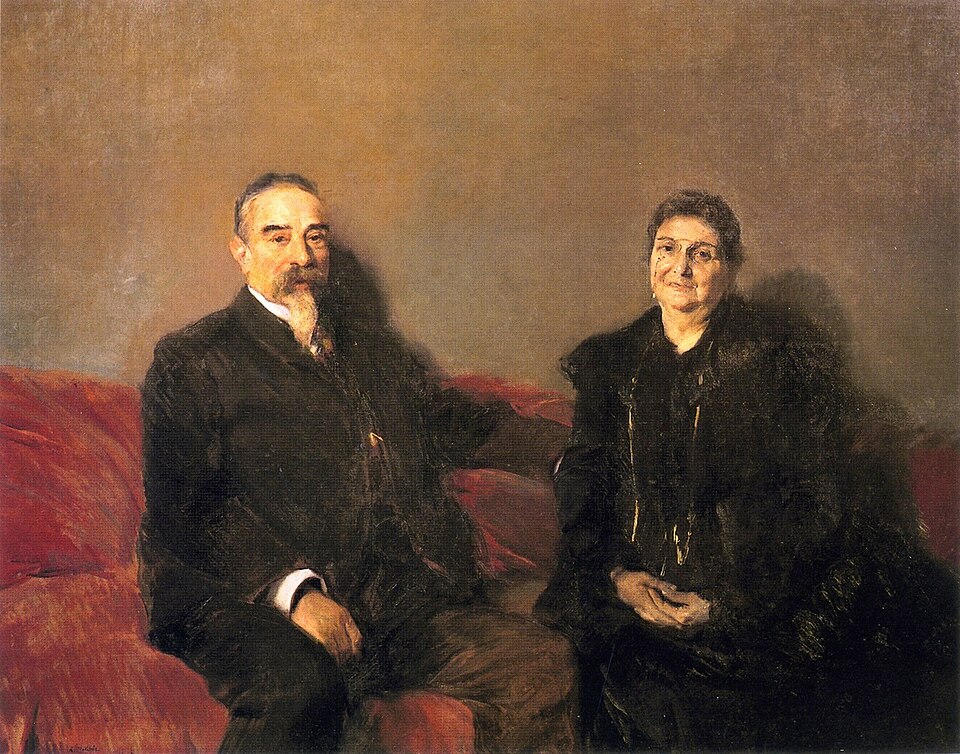
Los abuelos de mis hijos (The Grandparents of My Children), Joaquín Sorolla, 1905. Image: Wikimedia Commons, public domain Do this: Look at the picture together for a quiet minute before anyone talks.
Read aloud: Joaquín Sorolla painted his wife's parents, Antonio García, a photographer, and Clotilde del Castillo, side by side in one picture, so his children would have them always. Sorolla usually painted bright sunny beaches, but here he chose quiet colors: black clothes, a red sofa, a warm brown wall.
Point and find:
- Find el abuelo. What is on his face?
- Find la abuela. Is she smiling?
- What color is the sofa? Say it in Spanish.
- What are their hands doing?
Ask:
- “Why did Sorolla want his children to have this painting?”
- “What is something special you like to do with your grandparents?”
Show: How do you introduce your grandmother in Spanish?
Say this: “Grandmother is abuela.”
Say this: “She is a woman, so we say Esta es.”
Answer: Esta es mi abuela.
Show: How would a child lovingly call his grandpa?
Say this: “Grandpa is abuelo.”
Say this: “Adding -ito makes it small and dear.”
Answer: Abuelito.
Do this: Ask out loud. Let your child try first; help only after a real try.
Ask: What is el abuelo?
Listen for: The grandfather.
Ask: What is la abuela?
Listen for: The grandmother.
Ask: What does los abuelos mean?
Listen for: The grandparents.
3 more on the lesson page.
Read aloud: Make a card for your grandparents (or an older friend from church) and say what you love about them, with Spanish words inside.
Steps:
- On the front, draw your grandfather and grandmother together, like Sorolla's painting.
- Write Para mis abuelos (for my grandparents) on the front.
- Inside, write Te quiero, abuelo. Te quiero, abuela. (A parent can help.)
- Draw something you love to do with them.
- Give or mail the card, and say Te quiero when you give it.
Tips for you:
- If your grandparents are far away, call them and read the card on the phone.
- If your grandparents are in heaven, make the card for an older friend at church.
Done when your child can say:
- My card says Para mis abuelos and Te quiero.
- I gave it with a Spanish greeting.
Do this: Your child picks one or more; you write the date.
- Draw your grandparents and label el abuelo and la abuela.
- Write los abuelos under both of them together.
Read aloud: In many Spanish-speaking families, the grandparents live with or near their children and grandchildren, and the abuela is often the heart of the home, cooking the family recipes and teaching the little ones their first prayers. Many children learn the Lord's Prayer, the Padre Nuestro, from their grandmother.
- Saying ah-BOO-eh-loh. The ue slides together in one beat: ah-BWEH-loh.
- Saying Este es mi abuela. For a woman, use esta: Esta es mi abuela.
Set out stuffed animals or dolls as a pretend family: abuelo, abuela, mamá, papá, hermano, hermana, bebé. The child introduces each one to a parent: Este es el abuelo. Esta es la abuela. Then the parent mixes them up and the child sorts them back into the family, naming each one.
Say this: “Tell me what you learned today.”
Listen for: Name los abuelos: el abuelo (grandfather) and la abuela (grandmother).; Introduce family members with Este es mi... and Esta es mi...; Learn what the Bible says about grandparents and grandchildren.
Children’s children are the crown of old men; and the glory of children are their fathers.
In the Spanish Bible this verse begins Corona de los viejos son los hijos de los hijos: the crown of the old is their children's children. To your grandparents, you are a crown!
Spread over the week
3 sessions of 15–20 minutes. Stop while it is still going well.
- Session 1. Warm-up, then read and teach the new idea and the new words. Picture study and show how.
- Session 2. Practice together, then start the project. Finish the project, then the sketchbook.
- Session 3. Narration, the game and the Scripture.