Parent guide · Grade 1 Spanish · Unit 2
Lesson 2.1 My House
Written for the parent. The Read aloud parts are written to your child; read them as they are. Do this parts are for you. Answers for you are marked Listen for.
At a glance
- Time
- 3 sessions of 15–20 minutes
- Goal
- Name the parts of a house: la casa, la puerta, la ventana. Name the rooms: la cocina, el dormitorio, el baño, la sala. Label your own house in Spanish.
- You need
- Sticky notes or paper and tape
- A marker
- A sketchbook or plain paper, and crayons
- A King James Bible
- Worksheet A · the lesson page (it also has a short video (2:49))
Steps
Do this together: Take a little tour of your house with your parent. Walk through each room and say what it is. Today you learn the names of the rooms in Spanish.
Read aloud: The story. About three hundred and sixty years ago, in a country called Holland, there lived a painter named Pieter de Hooch. Holland was full of tidy brick houses with shiny tiled floors, and de Hooch loved to paint the inside of them, with the sunlight coming through the windows and the doors standing open from one room to the next. In this painting, two women stand by a tall wooden cupboard, putting away clean folded linen: sheets and towels. Look through the open door at the back, and you can see right out into the sunny street, and the houses across the way! A little girl plays in the hallway with a stick. Everything is neat and clean and bright. It is a picture of a home where people work hard and care for one another.
Read aloud: How Spanish sounds. In cocina, the c before i sounds like s: koh-SEE-nah. In puerta, the ue slides together: PWEHR-tah. And ventana begins with a v that sounds like a soft b: behn-TAH-nah.
Read aloud: Say it and move. Walk to the kitchen and stir a pretend pot: la cocina. Walk to the bedroom and yawn: el dormitorio. Knock on a door: la puerta. Look out a window: la ventana. Then spread your arms wide: ¡mi casa!
Do this: Say each word clearly; your child says it back twice. Point to a picture or the real thing when you can.
- la casa [lah KAH-sah]: the house
- la cocina [lah koh-SEE-nah]: the kitchen
- el dormitorio [ehl dohr-mee-TOH-ryoh]: the bedroom
- el baño [ehl BAH-nyoh]: the bathroom
- la sala [lah SAH-lah]: the living room
- la puerta [lah PWEHR-tah]: the door
- la ventana [lah behn-TAH-nah]: the window
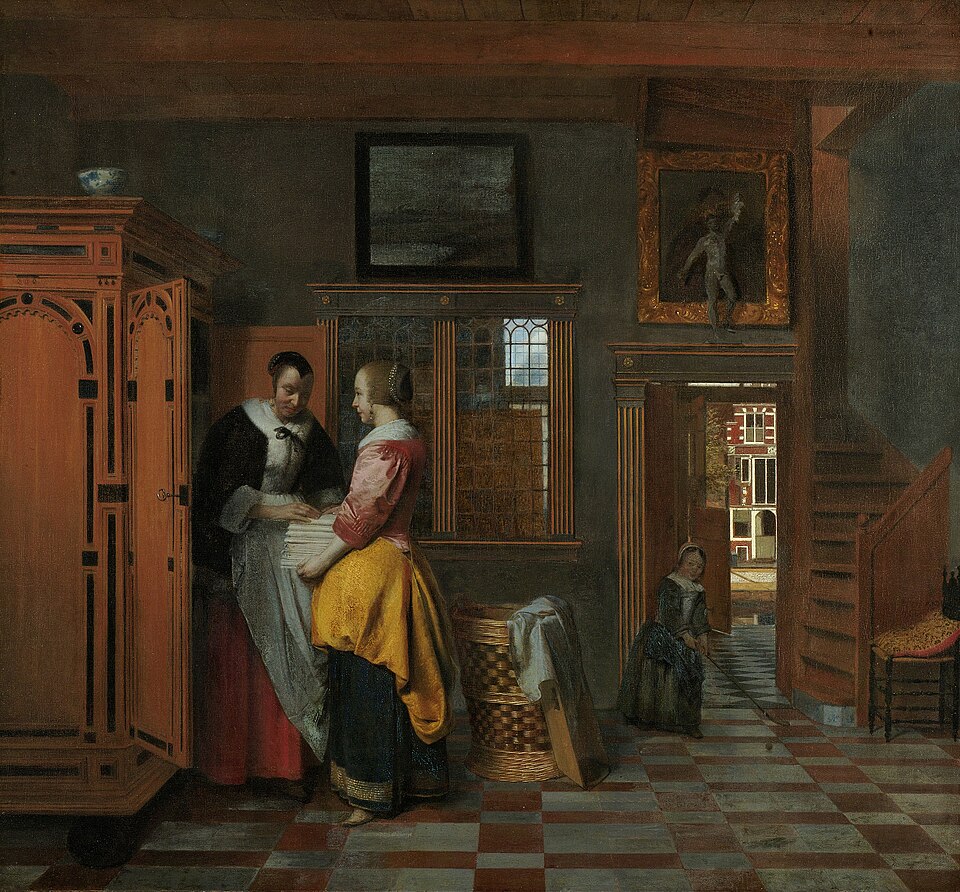
Interior with Women beside a Linen Cupboard, Pieter de Hooch, 1663. Image: Wikimedia Commons, public domain Do this: Look at the picture together for a quiet minute before anyone talks.
Read aloud: Pieter de Hooch loved to paint doorways that lead from one room to another and then outside. Here the lady of the house and her helper are putting clean linen away in the big cupboard. Paintings over the door and on the wall show that this family loved beautiful things.
Point and find:
- Find the big cupboard. What are the women putting inside it?
- Find the open puerta at the back. What can you see through it?
- Find the little girl. What is she doing?
- Find the ventana. Where does the light come from?
Ask:
- “Why do you think the painter made the doors open?”
- “How do you help keep your own home neat?”
Show: Where do we cook supper? Answer in Spanish.
Say this: “We cook in the kitchen.”
Say this: “Kitchen is la cocina; c before i sounds like s.”
Answer: En la cocina (in the kitchen).
Show: Where do you sleep? Answer in Spanish.
Say this: “We sleep in the bedroom.”
Say this: “Bedroom is el dormitorio.”
Answer: En el dormitorio.
Do this: Ask out loud. Let your child try first; help only after a real try.
Ask: What is la casa?
Listen for: The house.
Ask: What is la puerta?
Listen for: The door.
Ask: How do you say window in Spanish?
Listen for: La ventana.
3 more on the lesson page.
Read aloud: Put Spanish labels all over your house so you see the words every day.
Steps:
- A parent writes each word on a sticky note: la cocina, el dormitorio, el baño, la sala, la puerta, la ventana, la casa.
- Trace or copy each word in your own handwriting on a second note.
- Walk through the house and stick each label in the right place.
- Every time you pass a label this week, read it out loud.
Tips for you:
- Put la casa on the front door.
- Ask a brother or sister to take a tour of the house with you, in Spanish.
Done when your child can say:
- I put Spanish labels on rooms, doors and windows.
- I can name each room in Spanish.
Do this: Your child picks one or more; you write the date.
- Draw your house from the outside with its puerta and ventanas, and label them.
- Draw a little map of the rooms inside and label la cocina, el dormitorio and el baño.
Read aloud: Many houses in Spain and Latin America are built around a patio, an open courtyard in the middle of the house, often with flowers, a fountain or a tree. The rooms open onto the patio, and the family sits there in the cool of the evening. The English word patio comes from Spanish.
- Saying cocina with a k sound in the middle. Before i, c says s: koh-SEE-nah.
- Saying the v in ventana like an English v. It is a soft b: behn-TAH-nah.
Hide a small toy somewhere in the house. The child asks ¿Dónde está? (Where is it?) and the parent gives a Spanish clue: ¡En la cocina! The child runs to the kitchen to look. Then the child hides the toy and gives the clue.
Say this: “Tell me what you learned today.”
Listen for: Name the parts of a house: la casa, la puerta, la ventana.; Name the rooms: la cocina, el dormitorio, el baño, la sala.; Label your own house in Spanish.
And if it seem evil unto you to serve the LORD, choose you this day whom ye will serve; whether the gods which your fathers served that were on the other side of the flood, or the gods of the Amorites, in whose land ye dwell: but as for me and my house, we will serve the LORD.
In the Spanish Bible Joshua ends this verse: yo y mi casa serviremos á Jehová, I and my house will serve the Lord. Find your new word casa! A house is more than rooms; it is a family that loves God.
Spread over the week
3 sessions of 15–20 minutes. Stop while it is still going well.
- Session 1. Warm-up, then read and teach the new idea and the new words. Picture study and show how.
- Session 2. Practice together, then start the project. Finish the project, then the sketchbook.
- Session 3. Narration, the game and the Scripture.