Parent guide · Grade 1 Spanish · Unit 2
Lesson 2.2 At the Table
Written for the parent. The Read aloud parts are written to your child; read them as they are. Do this parts are for you. Answers for you are marked Listen for.
At a glance
- Time
- 3 sessions of 15–20 minutes
- Goal
- Name things at the table: la mesa, el plato, el vaso, la cuchara, el pan, la leche, el agua. Ask politely: Pan, por favor. Gracias. Say a grace in Spanish before meals.
- You need
- A large sheet of paper
- Crayons or markers
- Clear tape (optional, to cover it)
- A sketchbook or plain paper, and crayons
- A King James Bible
- Worksheet A · the lesson page (it also has a short video (3:11))
Steps
Do this together: What do we put on the table before a meal? Plates, cups, spoons... What do we say before we eat? Today you learn the table in Spanish, and a prayer to thank God for the food.
Read aloud: The story. About two hundred and eighty years ago in Paris, there lived a painter named Jean-Siméon Chardin. He painted quiet, ordinary moments in plain homes: a boy blowing bubbles, a girl playing with a top, a mother peeling vegetables. In one of his most loved paintings, a mother is setting the soup on the table for supper. Her two little girls sit at the table, and before anyone eats, the littlest one folds her hands to say grace, while her mother and her sister wait and watch her kindly. A little drum hangs on the back of her chair, but for now she has put away her play to thank God. The painting was so loved that Chardin painted it more than once, and the king of France owned one of them.
Read aloud: How Spanish sounds. In leche, ch sounds like the ch in church: LEH-cheh. Vaso begins with a soft b sound: BAH-soh. And remember: water is el agua, even though agua ends in a.
Read aloud: Say it and move. Tap the table: la mesa. Hold up a plate: el plato. Lift a cup: el vaso. Pretend to drink: la leche, el agua. Pretend to tear bread: el pan. Then fold your hands and pray: Gracias, Señor, por la comida. Amén.
Do this: Say each word clearly; your child says it back twice. Point to a picture or the real thing when you can.
- la mesa [lah MEH-sah]: the table
- el plato [ehl PLAH-toh]: the plate
- el vaso [ehl BAH-soh]: the glass, the cup
- la cuchara [lah koo-CHAH-rah]: the spoon
- el pan [ehl PAHN]: the bread
- la leche [lah LEH-cheh]: the milk
- el agua [ehl AH-gwah]: the water
- la comida [lah koh-MEE-dah]: the food, the meal
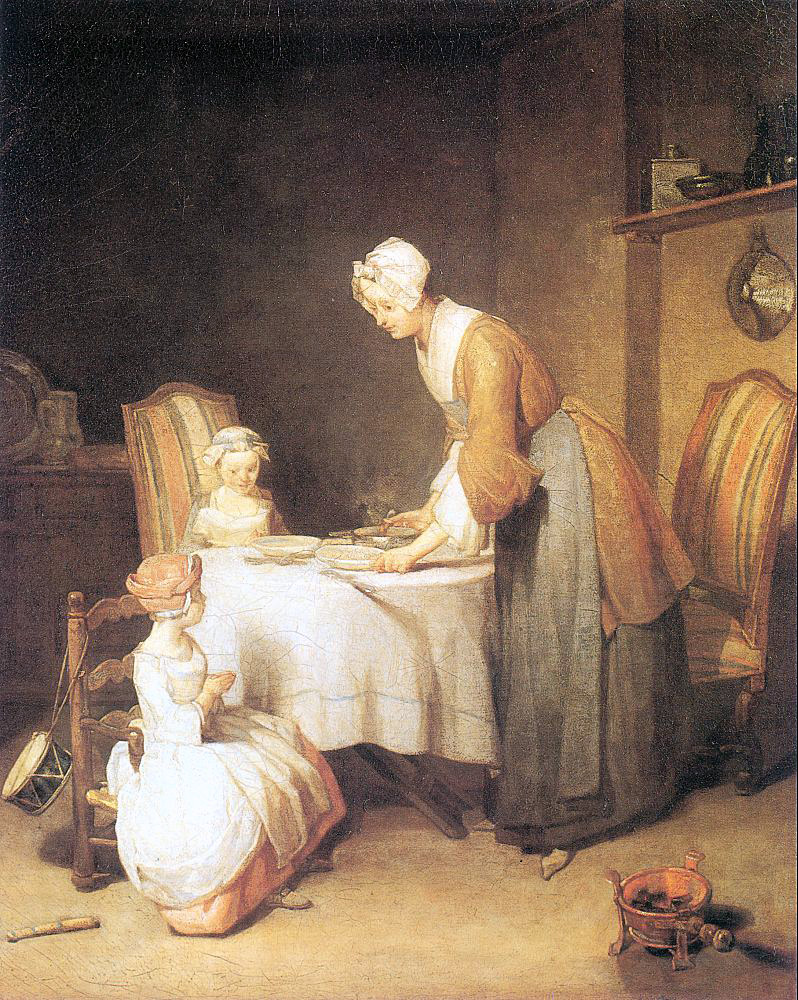
Le Bénédicité (Saying Grace), Jean-Siméon Chardin, c. 1740. Image: Wikimedia Commons, public domain Do this: Look at the picture together for a quiet minute before anyone talks.
Read aloud: Chardin painted this quiet supper in a simple Paris home. The mother has just brought the soup, and she pauses so the little one can say her prayer. Chardin used soft, warm colors and let the light fall on the white cloth, the white cap and the children's faces.
Point and find:
- Find the mother. What is she doing?
- Find the child with folded hands. What is she doing?
- Find the drum. Where is it hanging?
- Find la mesa. What color is the cloth on it?
Ask:
- “Why does the mother wait before serving the soup?”
- “What prayer does your family say before meals?”
Show: You want some bread. How do you ask politely in Spanish?
Say this: “Bread is el pan.”
Say this: “Add the magic word por favor.”
Answer: Pan, por favor. (And when you get it: ¡Gracias!)
Show: Before supper, what do you say to God in Spanish?
Say this: “Thank you is gracias; Lord is Señor.”
Say this: “For the food is por la comida.”
Answer: Gracias, Señor, por la comida. Amén.
Do this: Ask out loud. Let your child try first; help only after a real try.
Ask: What is la mesa?
Listen for: The table.
Ask: What is la leche?
Listen for: The milk.
Ask: How do you say water in Spanish?
Listen for: El agua.
3 more on the lesson page.
Read aloud: Make a placemat for your place at the table, with the table words in Spanish and the grace across the top.
Steps:
- A parent writes Gracias, Señor, por la comida across the top. Trace it.
- In the middle, draw a plate (el plato). Beside it, draw a glass (el vaso) and a spoon (la cuchara).
- Draw bread (el pan) and milk (la leche) near the plate.
- Label each drawing in Spanish.
- Use your placemat at a real meal, and say the grace before you eat.
Tips for you:
- Say ¡Buen provecho! (enjoy your meal) when everyone starts eating.
- Ask for things politely: Leche, por favor. Gracias.
Done when your child can say:
- My placemat has the grace and five table words in Spanish.
- I said the grace at a real meal.
Do this: Your child picks one or more; you write the date.
- Draw a table set for supper and label la mesa, el plato, el vaso and el pan.
- Copy the grace: Gracias, Señor, por la comida. Amén.
Read aloud: In Spain and Latin America, the big meal of the day is often eaten in the middle of the day, and families like to stay at the table afterward, talking and telling stories. This time after the meal even has its own name, la sobremesa: the time over the table.
- Saying la agua. Water takes el: el agua.
- Saying leche with a k sound. The ch is like church: LEH-cheh.
Set five things on the table: a plate, a cup, a spoon, a piece of bread and a napkin. Name them in Spanish together. The child closes his or her eyes while a parent takes one away and asks ¿Qué falta? The child names the missing thing in Spanish. Then switch.
Say this: “Tell me what you learned today.”
Listen for: Name things at the table: la mesa, el plato, el vaso, la cuchara, el pan, la leche, el agua.; Ask politely: Pan, por favor. Gracias.; Say a grace in Spanish before meals.
The eyes of all wait upon thee; and thou givest them their meat in due season.
In the Spanish Bible this verse says tú les das su comida en su tiempo: you give them their food in due season. Comida, food, is the same word as in our grace: Gracias, Señor, por la comida.
Spread over the week
3 sessions of 15–20 minutes. Stop while it is still going well.
- Session 1. Warm-up, then read and teach the new idea and the new words. Picture study and show how.
- Session 2. Practice together, then start the project. Finish the project, then the sketchbook.
- Session 3. Narration, the game and the Scripture.