Parent guide · Grade 1 Spanish · Unit 3
Lesson 3.1 The Days of the Week
Written for the parent. The Read aloud parts are written to your child; read them as they are. Do this parts are for you. Answers for you are marked Listen for.
At a glance
- Time
- 3 sessions of 15–20 minutes
- Goal
- Say the seven days of the week in Spanish: lunes to domingo. Say what day it is today: Hoy es... Know that domingo means the Lord's day.
- You need
- A paper plate
- A paper arrow and a brad fastener (or a clothespin)
- Crayons or markers
- A sketchbook or plain paper, and crayons
- A King James Bible
- Worksheet A · the lesson page (it also has a short video (2:10))
Steps
Do this together: What day is it today? What day was yesterday? What day is tomorrow? Which day do we go to church? Today you learn the days in Spanish, and a secret hidden in the name of Sunday.
Read aloud: The story. About one hundred and seventy years ago in New England, there lived a painter named George Henry Durrie. He loved winter, and he painted the snowy farms and villages of Connecticut so beautifully that his paintings were printed and hung in homes all over America. In this painting it is a cold, bright Sunday morning. Snow covers the ground and the roofs. In the middle of the village stands a white church with a tall steeple, and from every direction families are coming to worship: some walking through the snow, some riding in horse-drawn sleighs with warm blankets over their knees. The whole village is going to church together on the Lord's day.
Read aloud: How Spanish sounds. In Spanish, the days of the week begin with small letters, not capitals: lunes, martes. The names are old: lunes is the moon's day, and domingo comes from the Latin dies Dominicus, the day of the Lord, because Jesus rose from the dead on a Sunday. In jueves the j is a breathy h: HWEH-behs.
Read aloud: Say it and move. Clap once for each day as you say it: lunes, martes, miércoles, jueves, viernes, sábado, and for domingo, fold your hands as if in church. Then point to today on a calendar and say: Hoy es...
Do this: Say each word clearly; your child says it back twice. Point to a picture or the real thing when you can.
- lunes [LOO-nehs]: Monday
- martes [MAHR-tehs]: Tuesday
- miércoles [MYEHR-koh-lehs]: Wednesday
- jueves [HWEH-behs]: Thursday
- viernes [BYEHR-nehs]: Friday
- sábado [SAH-bah-doh]: Saturday
- domingo [doh-MEEN-goh]: Sunday
- hoy [OY]: today
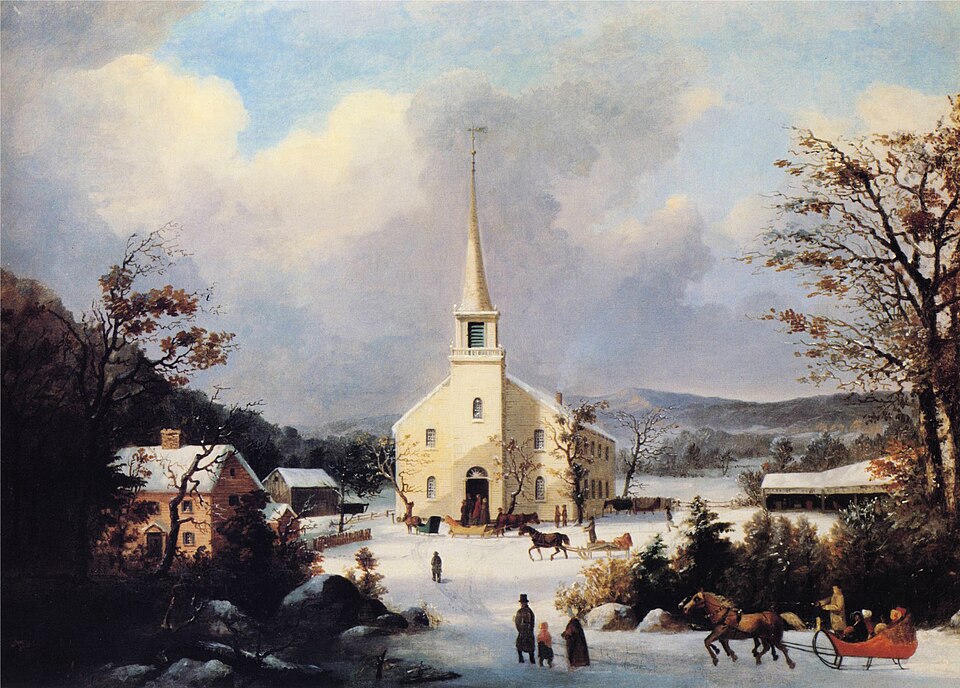
Going to Church, George Henry Durrie, 1853. Image: Wikimedia Commons, public domain Do this: Look at the picture together for a quiet minute before anyone talks.
Read aloud: George Henry Durrie painted the winter countryside around New Haven, Connecticut. A printing company called Currier and Ives made prints of his winter scenes, and families hung them on their walls, especially at Christmas. This one shows a whole village going to church through the snow.
Point and find:
- Find the church. What is on top of it?
- Find the red sleigh. What is pulling it?
- Find people walking. Where are they going?
- What color is the snow? Say it in Spanish.
Ask:
- “Why do you think everyone in the village is going the same way?”
- “How does your family get ready for church on domingo?”
Show: Today is Monday. Say it in Spanish.
Say this: “Today is is hoy es.”
Say this: “Monday is lunes, with a small letter.”
Answer: Hoy es lunes.
Show: What day comes after viernes?
Say this: “Viernes is Friday.”
Say this: “Next comes Saturday: sábado.”
Answer: Sábado.
Do this: Ask out loud. Let your child try first; help only after a real try.
Ask: What is lunes?
Listen for: Monday.
Ask: How do you say Sunday in Spanish?
Listen for: Domingo.
Ask: What does Hoy es... mean?
Listen for: Today is...
3 more on the lesson page.
Read aloud: Make a wheel with the seven days in Spanish, and turn the arrow every morning.
Steps:
- Divide the plate into seven slices, like a pie.
- A parent writes one day in each slice, in order: lunes, martes, miércoles, jueves, viernes, sábado, domingo. Trace them.
- Draw a little church in the domingo slice.
- Fasten the arrow in the middle (or clip a clothespin to the edge).
- Every morning, turn the arrow to today and say: Hoy es...
Tips for you:
- Color domingo in a special color: it is the Lord's day.
- Sing the days song while you turn the wheel all the way around.
Done when your child can say:
- My wheel has all seven days in Spanish, in order.
- I can say Hoy es... with the right day.
Do this: Your child picks one or more; you write the date.
- Write the seven days in Spanish down the page, one on each line.
- Next to domingo, draw your church.
Read aloud: In Spain and Latin America, the calendar on the wall usually starts with lunes, Monday, not Sunday. Sunday, domingo, comes at the end of the week, as the day of rest and worship after six days of work.
- Writing the days with capital letters. In Spanish, lunes and domingo begin with small letters.
- Saying jueves with an English j. It is a breathy h: HWEH-behs.
The parent says a day in Spanish, and the child says the day that comes next. ¡Martes! ¡Miércoles! Then go backward: the parent says a day and the child says the day before. For extra fun, play while jumping rope or bouncing a ball.
Say this: “Tell me what you learned today.”
Listen for: Say the seven days of the week in Spanish: lunes to domingo.; Say what day it is today: Hoy es...; Know that domingo means the Lord's day.
This is the day which the LORD hath made; we will rejoice and be glad in it.
In the Spanish Bible this verse says Este es el día que hizo Jehová: this is the day the Lord made. Every día of the week is His, and domingo, the Lord's day, is set apart to worship Him.
Spread over the week
3 sessions of 15–20 minutes. Stop while it is still going well.
- Session 1. Warm-up, then read and teach the new idea and the new words. Picture study and show how.
- Session 2. Practice together, then start the project. Finish the project, then the sketchbook.
- Session 3. Narration, the game and the Scripture.