Parent guide · Grade 1 Spanish · Unit 3
Lesson 3.2 What Is the Weather Like?
Written for the parent. The Read aloud parts are written to your child; read them as they are. Do this parts are for you. Answers for you are marked Listen for.
At a glance
- Time
- 3 sessions of 15–20 minutes
- Goal
- Ask ¿Qué tiempo hace? (What is the weather like?). Answer with hace sol, llueve, hace frío, hace calor, hace viento. Thank God, who sends the sun and the rain.
- You need
- A paper plate
- A paper arrow and a brad fastener (or a clothespin)
- Crayons or markers
- A sketchbook or plain paper, and crayons
- A King James Bible
- Worksheet A · the lesson page (it also has a short video (2:17))
Steps
Do this together: Look out the window. Is it sunny? Rainy? Cloudy? Windy? Is it hot or cold? Today you learn to talk about the weather in Spanish.
Read aloud: The story. About one hundred and fifty years ago, Paris, the great city of France, was being rebuilt with wide new streets and tall stone buildings. A painter named Gustave Caillebotte lived there, and he loved to paint the new city. In his most famous painting, it is a rainy day. The cobblestones shine wet and gray. A gentleman in a top hat and a lady in a long dark dress walk together under one big umbrella, coming right toward us. Behind them, other people hurry across the street under their own umbrellas, and a tall green lamppost stands in the middle of it all. You can almost hear the rain pattering on the umbrellas. When you look at this painting, you want to say: ¡Llueve!
Read aloud: How Spanish sounds. Spanish talks about weather with hace, which really means it makes: hace sol (it makes sun), hace frío (it makes cold). The h is quiet: AH-seh. For rain there is one short word: llueve, it rains, with ll like y: YWEH-beh.
Read aloud: Say it and move. Make a circle over your head for the sun: Hace sol. Wiggle your fingers down: Llueve. Shiver: Hace frío. Fan your face: Hace calor. Sway like a tree: Hace viento.
Do this: Say each word clearly; your child says it back twice. Point to a picture or the real thing when you can.
- el tiempo [ehl TYEHM-poh]: the weather (also: time)
- el sol [ehl SOHL]: the sun
- la lluvia [lah YOO-byah]: the rain
- llueve [YWEH-beh]: it is raining
- hace frío [AH-seh FREE-oh]: it is cold
- hace calor [AH-seh kah-LOHR]: it is hot
- el viento [ehl BYEHN-toh]: the wind
- el paraguas [ehl pah-RAH-gwahs]: the umbrella
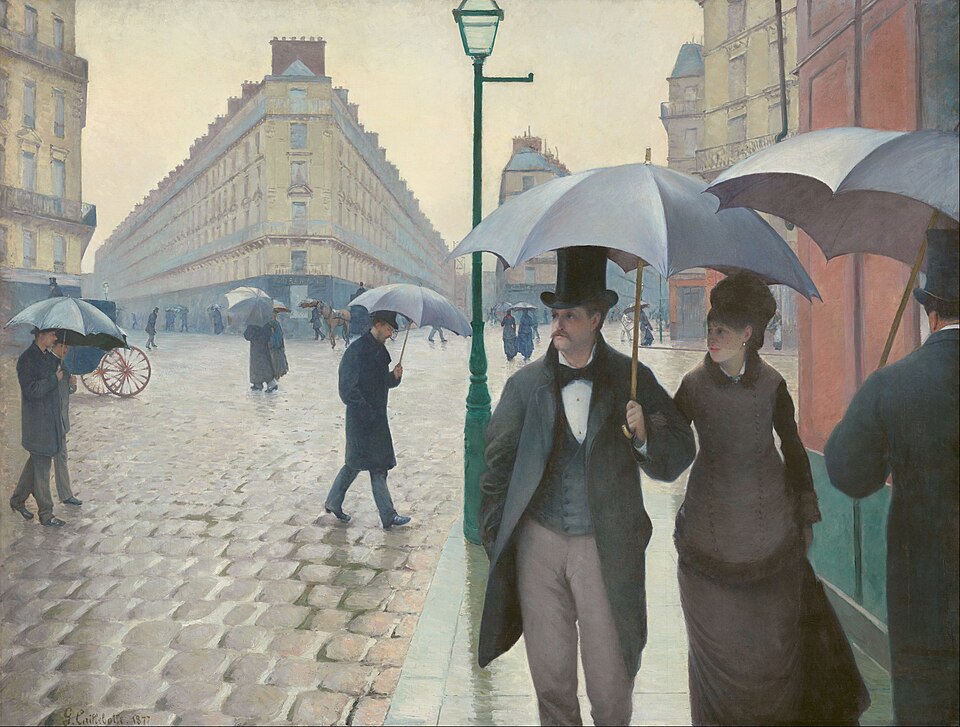
Paris Street; Rainy Day, Gustave Caillebotte, 1877. Image: Wikimedia Commons, public domain Do this: Look at the picture together for a quiet minute before anyone talks.
Read aloud: Caillebotte painted this huge picture, taller than a man, of a street corner near his home in Paris. He painted it very carefully, like a photograph, so that the wet stones shine and the umbrellas glisten. Everyone in the painting is busy, but no one is in a hurry.
Point and find:
- Count the umbrellas in Spanish.
- Find the green lamppost. Where does it stand?
- Find the wet cobblestones. How can you tell they are wet?
- ¿Qué tiempo hace en el cuadro? (What is the weather in the picture?)
Ask:
- “What do you like to do on a rainy day?”
- “Why do we need rain, even if we would rather play in the sun?”
Show: It is snowing and very cold. ¿Qué tiempo hace?
Say this: “Cold is frío.”
Say this: “Spanish says it makes cold: hace frío.”
Answer: Hace frío.
Show: The rain is falling. Say it in Spanish.
Say this: “It rains is one word: llueve.”
Answer: Llueve.
Do this: Ask out loud. Let your child try first; help only after a real try.
Ask: What does hace sol mean?
Listen for: It is sunny.
Ask: What does llueve mean?
Listen for: It is raining.
Ask: How do you say it is cold in Spanish?
Listen for: Hace frío.
3 more on the lesson page.
Read aloud: Make a weather wheel and turn it every morning to show the weather in Spanish.
Steps:
- Divide the plate into five slices.
- In each slice draw one kind of weather: a sun, rain, a snowflake (cold), a hot red sun (hot), and the wind.
- A parent writes the Spanish under each: hace sol, llueve, hace frío, hace calor, hace viento. Trace them.
- Fasten the arrow in the middle.
- Each morning, look outside, ask ¿Qué tiempo hace?, turn the arrow, and say the weather.
Tips for you:
- Keep your week wheel and weather wheel side by side: Hoy es martes. Hace sol.
- For cloudy days, add está nublado.
Done when your child can say:
- My weather wheel has five kinds of weather in Spanish.
- I can ask and answer ¿Qué tiempo hace?
Do this: Your child picks one or more; you write the date.
- Draw four boxes: a sunny day, a rainy day, a cold day and a windy day. Label each in Spanish.
- Draw the umbrella from the painting and write llueve under it.
Read aloud: Because the Spanish-speaking world is so big, the weather is very different from place to place. When it is cold winter in Spain and Mexico, it is warm summer in Argentina and Chile, on the other side of the equator, and families there celebrate Christmas in the summer heat.
- Saying the h in hace. It is quiet: AH-seh.
- Saying es frío for the weather. Spanish says hace frío.
One player acts out a kind of weather without speaking, shivering for cold, fanning for hot, holding an umbrella for rain, and the other guesses in Spanish: ¡Hace frío! ¡Llueve! Then switch.
Say this: “Tell me what you learned today.”
Listen for: Ask ¿Qué tiempo hace? (What is the weather like?).; Answer with hace sol, llueve, hace frío, hace calor, hace viento.; Thank God, who sends the sun and the rain.
Who covereth the heaven with clouds, who prepareth rain for the earth, who maketh grass to grow upon the mountains.
In the Spanish Bible this verse says el que prepara la lluvia para la tierra: He prepares the rain for the earth. Lluvia is rain, from the same family as llueve. Sun or rain, every kind of weather comes from God's hand.
Spread over the week
3 sessions of 15–20 minutes. Stop while it is still going well.
- Session 1. Warm-up, then read and teach the new idea and the new words. Picture study and show how.
- Session 2. Practice together, then start the project. Finish the project, then the sketchbook.
- Session 3. Narration, the game and the Scripture.