Parent guide · Grade 1 Spanish · Unit 4
Lesson 4.1 Eleven to Twenty
Written for the parent. The Read aloud parts are written to your child; read them as they are. Do this parts are for you. Answers for you are marked Listen for.
At a glance
- Time
- 3 sessions of 15–20 minutes
- Goal
- Count from once (11) to veinte (20) in Spanish. Count things in a busy painting. Know that Jesus chose doce (twelve) apostles.
- You need
- Strips of colored paper (20)
- A marker
- Tape or glue
- A sketchbook or plain paper, and crayons
- A King James Bible
- Worksheet A · the lesson page (it also has a short video (1:03))
Steps
Do this together: Count to ten in Spanish as a warm-up: uno, dos, tres... diez! Now, what comes after ten? Today you learn to keep counting all the way to twenty.
Read aloud: The story. About four hundred and sixty years ago, in the land of Flanders, there lived a painter named Pieter Bruegel. He liked to paint whole villages full of people, from high above, as if he were a bird looking down. In one painting he painted nothing but children playing, more than two hundred of them, in the streets and the square of a town! They are playing leapfrog and blindman's buff, rolling hoops and barrels, spinning tops, walking on stilts, riding on each other's backs, playing dolls and hiding behind doors. There are more than eighty different games in the painting. Scholars have tried to count them all. Can you count to twenty children? Uno, dos, tres... and keep going: once, doce, trece... veinte!
Read aloud: How Spanish sounds. The numbers 11 to 15 have their own names: once, doce, trece, catorce, quince. The numbers 16 to 19 are made from diez y (ten and): dieciséis (ten and six), diecisiete, dieciocho, diecinueve. Then comes veinte, twenty: BAYN-teh.
Read aloud: Say it and move. Do twenty jumping jacks, counting in Spanish. For once to quince, jump; for dieciséis to diecinueve, hop on one foot; and for veinte, jump as high as you can!
Do this: Say each word clearly; your child says it back twice. Point to a picture or the real thing when you can.
- once [OHN-seh]: eleven
- doce [DOH-seh]: twelve
- trece [TREH-seh]: thirteen
- catorce [kah-TOHR-seh]: fourteen
- quince [KEEN-seh]: fifteen
- dieciséis [dyeh-see-SAYS]: sixteen
- veinte [BAYN-teh]: twenty
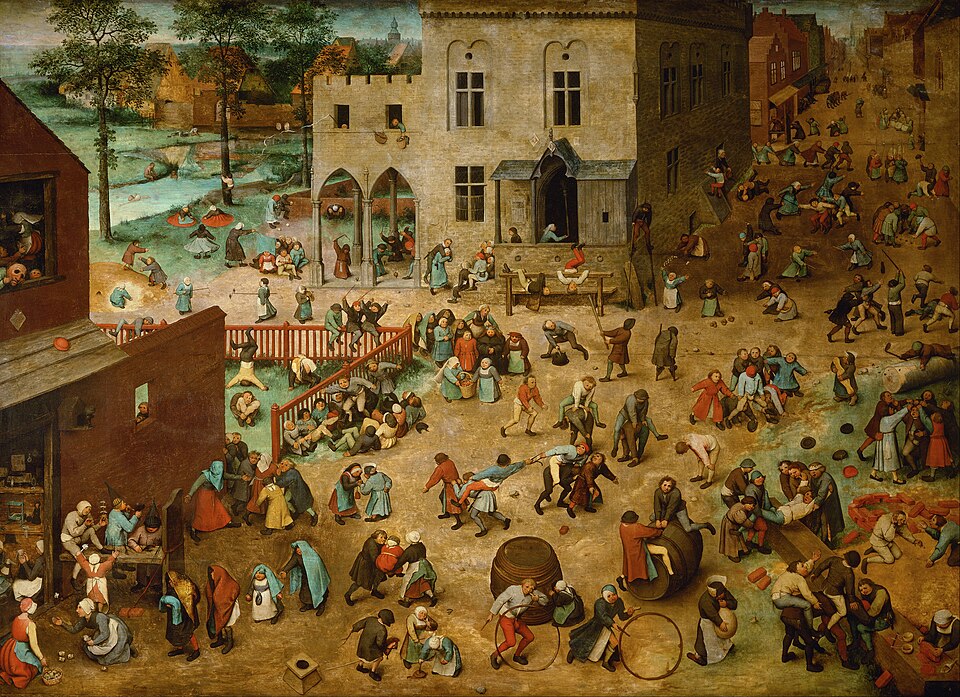
Children's Games, Pieter Bruegel the Elder, 1560. Image: Wikimedia Commons, public domain Do this: Look at the picture together for a quiet minute before anyone talks.
Read aloud: Pieter Bruegel painted this crowded picture in Antwerp, in Flanders, which was then ruled by the king of Spain. Bruegel loved ordinary people and painted them with humor and care. Look closely, one corner at a time; there is always something new to find.
Point and find:
- Find a child rolling a hoop.
- Find children playing leapfrog.
- Count twenty children in Spanish, pointing to each one.
- Find a game you know how to play.
Ask:
- “Which game in the painting would you most like to play?”
- “Why do you think Bruegel painted so many children?”
Show: How do you say fifteen in Spanish?
Say this: “11 to 15 have their own names: once, doce, trece, catorce, quince.”
Answer: Quince.
Show: How do you say eighteen in Spanish?
Say this: “Eighteen is ten and eight: diez y ocho.”
Say this: “Squeeze it into one word.”
Answer: Dieciocho.
Do this: Ask out loud. Let your child try first; help only after a real try.
Ask: What number is doce?
Listen for: Twelve.
Ask: How do you say twenty in Spanish?
Listen for: Veinte.
Ask: What number is once?
Listen for: Eleven.
3 more on the lesson page.
Read aloud: Make a paper chain with twenty links, one for each number, and count it every day.
Steps:
- A parent writes a number and its Spanish name on each strip: 1 uno to 20 veinte.
- Trace the numbers 11 to 20 yourself.
- Make a loop with strip 1 and tape it closed. Link strip 2 through it, and so on, to 20.
- Hang the chain and count it out loud in Spanish from uno to veinte.
- Count backward too, from veinte to uno.
Tips for you:
- Use a special color for doce: the twelve apostles.
- Count the chain each morning before breakfast.
Done when your child can say:
- My chain has twenty links with Spanish numbers.
- I can count from 1 to 20 in Spanish.
Do this: Your child picks one or more; you write the date.
- Write the numbers 11 to 20 with their Spanish names.
- Draw twelve little men and write doce apóstoles.
Read aloud: Children in Spain and Latin America play many of the same games Bruegel painted: hopscotch (called la rayuela), tag, hide-and-seek (el escondite) and spinning tops (el trompo). Many of these games are hundreds of years old.
- Saying once like the English word once. In Spanish it is OHN-seh.
- Saying diez seis. Sixteen is one word: dieciséis.
Stand at one side of a room or yard. The parent calls a number from 11 to 20 in Spanish, and the child takes that many steps, counting out loud in Spanish. Who reaches the other side first? Then the child calls the numbers.
Say this: “Tell me what you learned today.”
Listen for: Count from once (11) to veinte (20) in Spanish.; Count things in a busy painting.; Know that Jesus chose doce (twelve) apostles.
And he ordained twelve, that they should be with him, and that he might send them forth to preach,
In the Spanish Bible this verse begins Y estableció doce, para que estuviesen con él: and He appointed twelve, that they should be with Him. Find doce! Jesus chose twelve apostles to be with Him and to go and preach.
Spread over the week
3 sessions of 15–20 minutes. Stop while it is still going well.
- Session 1. Warm-up, then read and teach the new idea and the new words. Picture study and show how.
- Session 2. Practice together, then start the project. Finish the project, then the sketchbook.
- Session 3. Narration, the game and the Scripture.