Parent guide · Grade 2 Spanish · Unit 1
Lesson 1.1 Things at School
Written for the parent. The Read aloud parts are written to your child; read them as they are. Do this parts are for you. Answers for you are marked Listen for.
At a glance
- Time
- 3 sessions of 15–20 minutes
- Goal
- Name school things in Spanish: el libro, el lápiz, el papel, la mesa, la silla. Say la maestra / el maestro for teacher. Understand classroom phrases: Escucha, Levanta la mano, Siéntate.
- You need
- Index cards or paper squares
- Crayons or markers
- Tape
- A sketchbook or plain paper, and crayons
- A King James Bible
- Worksheet A · the lesson page (it also has a short video (2:23))
Steps
Do this together: Where do you do your school work? What do you need: a book, a pencil, paper? Who teaches you? Today you learn the names of school things in Spanish.
Read aloud: The story. About one hundred and fifty years ago, many American children went to school in a single room. All the grades sat together, the big children and the little ones, with one teacher for everyone. Winslow Homer, an American painter who had drawn pictures of soldiers during the Civil War, painted one of these country schools on a bright summer day. Sunlight pours in through the tall windows. The young teacher stands in the middle, holding a book, behind her wooden desk with a little bunch of flowers on it. The boys sit on a long bench on one side of the room and the girls on the other, with their books open on their knees. Some children are barefoot. A small boy near the front has his hand to his face, as if he is crying or cannot find the answer. The teacher is patient: she will help him.
Read aloud: How Spanish sounds. Lápiz leans on the first part, as the accent shows, and the z sounds like s: LAH-pees. Silla has the double ll that sounds like y: SEE-yah. A woman teacher is la maestra; a man teacher is el maestro.
Read aloud: Say it and move. Hold up each thing as you say it: el libro, el lápiz, el papel. Pat the table: la mesa. Sit down: la silla. Then play teacher: one person says Levanta la mano and everyone raises a hand; Escucha and everyone cups an ear; Siéntate and everyone sits.
Do this: Say each word clearly; your child says it back twice. Point to a picture or the real thing when you can.
- la escuela [lah ehs-KWEH-lah]: the school
- el libro [ehl LEE-broh]: the book
- el lápiz [ehl LAH-pees]: the pencil
- el papel [ehl pah-PEHL]: the paper
- la mesa [lah MEH-sah]: the table, desk
- la silla [lah SEE-yah]: the chair
- la maestra [lah mah-EHS-trah]: the teacher
- escucha [ehs-KOO-chah]: listen!
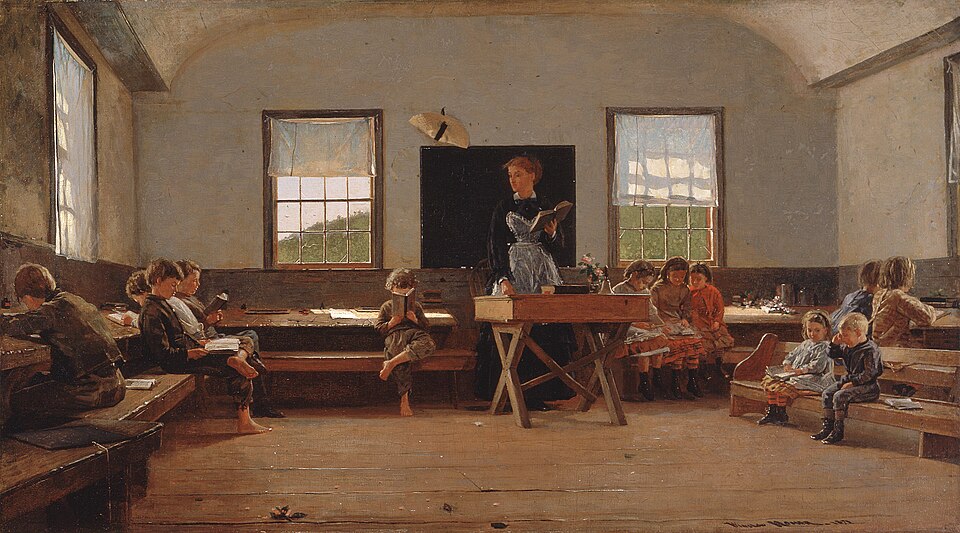
The Country School, Winslow Homer, 1871. Image: Wikimedia Commons, public domain Do this: Look at the picture together for a quiet minute before anyone talks.
Read aloud: Winslow Homer painted country life in America after the Civil War: children at play, farms and the sea. Here he shows an ordinary school, with its plain room and long benches, as something beautiful and full of light.
Point and find:
- Find the teacher. What is she holding?
- Find the flowers on her desk.
- Count the windows in Spanish.
- Find the boy who looks sad. Why do you think he is sad?
Ask:
- “How is this school like the place where you learn? How is it different?”
- “What would you like to learn if you were in this school?”
Show: You need something to write with. Ask for it in Spanish.
Say this: “Pencil is el lápiz.”
Say this: “Please is por favor.”
Answer: El lápiz, por favor.
Show: The teacher says Levanta la mano. What do you do?
Say this: “Levanta means raise; la mano means the hand.”
Answer: You raise your hand.
Do this: Ask out loud. Let your child try first; help only after a real try.
Ask: What is el libro?
Listen for: The book.
Ask: What is la silla?
Listen for: The chair.
Ask: How do you say the pencil in Spanish?
Listen for: El lápiz.
3 more on the lesson page.
Read aloud: Make little name cards in Spanish and tape them onto real things where you do school.
Steps:
- A parent writes the Spanish words on cards: el libro, el lápiz, el papel, la mesa, la silla, la puerta, la ventana.
- Copy each word yourself on a second card and draw a small picture next to it.
- Tape each card onto the real thing.
- Walk around and read every label aloud.
- Leave the labels up all week and say the words each time you use the thing.
Tips for you:
- Add el crayón, las tijeras and la mochila if you like.
- Play teacher with a stuffed animal class, using Escucha and Levanta la mano.
Done when your child can say:
- I made labels for at least five school things.
- I can read and say every label.
Do this: Your child picks one or more; you write the date.
- Draw a book, a pencil, a sheet of paper, a table and a chair. Copy the Spanish name under each.
- Draw your teacher and write la maestra or el maestro.
Read aloud: In Spain and Latin America, children often call their teacher maestra or maestro, or seño (short for señorita) in Spain, and they say Buenos días, maestra when they come into class. Many schools begin the year in September in Spain and Mexico, but in February or March in Argentina and Chile.
- Saying lápiz with a z sound. In Latin American Spanish it is LAH-pees.
- Saying silla with an l sound. The ll sounds like y: SEE-yah.
Like Simon Says. The teacher calls out actions in Spanish: Maestro dice: levanta la mano. Maestro dice: toca el libro (touch the book). Maestro dice: siéntate. If the teacher leaves off Maestro dice, don't move! Take turns being the teacher.
Say this: “Tell me what you learned today.”
Listen for: Name school things in Spanish: el libro, el lápiz, el papel, la mesa, la silla.; Say la maestra / el maestro for teacher.; Understand classroom phrases: Escucha, Levanta la mano, Siéntate.
The fear of the LORD is the beginning of knowledge: but fools despise wisdom and instruction.
In the Spanish Bible this verse begins El principio de la sabiduría es el temor de Jehová: the beginning of wisdom is the fear of the Lord. All good learning, at school or at home, starts with honoring God.
Spread over the week
3 sessions of 15–20 minutes. Stop while it is still going well.
- Session 1. Warm-up, then read and teach the new idea and the new words. Picture study and show how.
- Session 2. Practice together, then start the project. Finish the project, then the sketchbook.
- Session 3. Narration, the game and the Scripture.