Parent guide · Grade 2 Spanish · Unit 1
Lesson 1.2 The Alphabet and the Vowels
Written for the parent. The Read aloud parts are written to your child; read them as they are. Do this parts are for you. Answers for you are marked Listen for.
At a glance
- Time
- 3 sessions of 15–20 minutes
- Goal
- Sing the Spanish alphabet. Say the five Spanish vowels: a, e, i, o, u. Know the letter ñ.
- You need
- Five large cards or paper squares
- Crayons or markers
- A sketchbook or plain paper, and crayons
- A King James Bible
- Worksheet A · the lesson page (it also has a short video (1:31))
Steps
Do this together: Sing the ABCs in English. How many letters are there? Today you learn the Spanish alphabet: almost the same letters, but some have new names, and there is one extra letter English does not have.
Read aloud: The story. About three hundred years ago in Paris, a painter named Jean-Siméon Chardin loved to paint quiet moments at home: a mother saying grace with her children, a boy building a house of cards, a girl with a shuttlecock. In this painting a young girl, perhaps a big sister, leans over a little wooden cabinet. She holds a long pin and points to a letter in a small book. On the other side, a little child in a cap stares hard at the page, trying to read. The big girl is patient and gentle. She is the young schoolmistress, the little teacher. Long ago, many children first learned their letters from an older sister or brother just like this.
Read aloud: How Spanish sounds. Spanish vowels are easy because each one always makes the same sound: a (ah, as in father), e (eh, as in bed), i (ee, as in see), o (oh), u (oo, as in moon). So if you know the vowels, you can read almost any Spanish word aloud! Spanish also has the letter ñ, called eñe, which sounds like the ny in canyon: niño, España, mañana. The Spanish alphabet has 27 letters.
Read aloud: Say it and move. Make each vowel with your body: stretch your arms up in a point for A, stand sideways with arms out for E, stand straight and tall for I, make a big circle with your arms for O, and hold your arms up in a cup for U. Then do them fast: a, e, i, o, u!
Do this: Say each word clearly; your child says it back twice. Point to a picture or the real thing when you can.
- el abecedario [ehl ah-beh-seh-DAH-ryoh]: the alphabet
- la letra [lah LEH-trah]: the letter
- la vocal [lah boh-KAHL]: the vowel
- leer [leh-EHR]: to read
- el niño [ehl NEE-nyoh]: the boy (child)
- la palabra [lah pah-LAH-brah]: the word
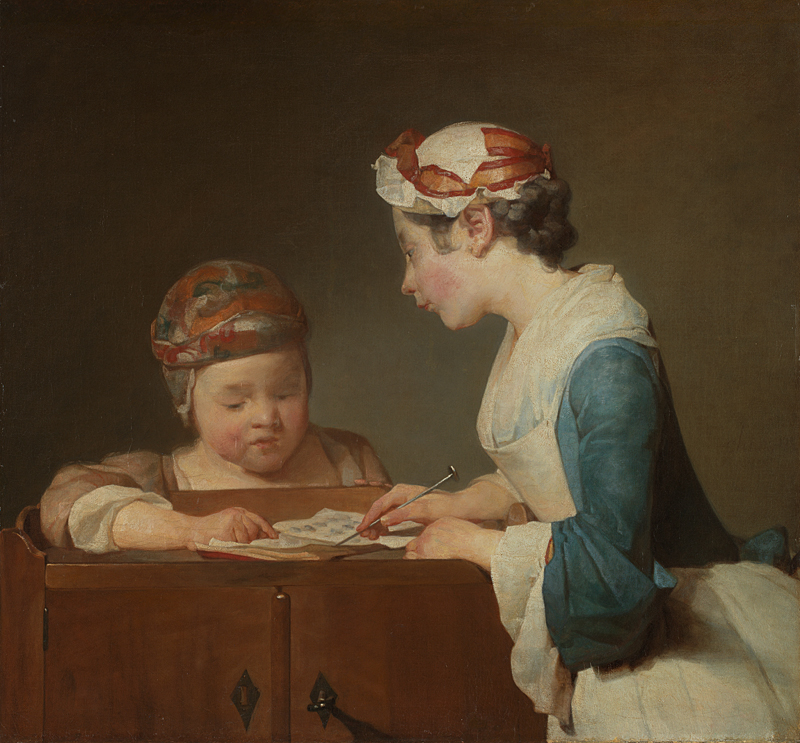
The Young Schoolmistress, Jean-Siméon Chardin, about 1735–6. Image: Wikimedia Commons, public domain Do this: Look at the picture together for a quiet minute before anyone talks.
Read aloud: Chardin painted ordinary people at home in soft light and gentle colors. He worked slowly and painted the same scenes more than once, because people loved them. Here he paints a lesson that takes only a minute but matters for a lifetime: learning to read.
Point and find:
- What is the big girl holding? What is she pointing to?
- Look at the little child's face. Is it easy or hard to read?
- Find the red ribbon in her cap. Say rojo.
- Who taught you your letters?
Ask:
- “Why do you think the big girl is so patient?”
- “Could you help a younger child learn the Spanish vowels?”
Show: How do you read the Spanish word mesa?
Say this: “m-e-sa: e is always eh, a is always ah.”
Answer: MEH-sah.
Show: Spell the word sol aloud in Spanish.
Say this: “s is ese, o is o, l is ele.”
Answer: Ese, o, ele.
Do this: Ask out loud. Let your child try first; help only after a real try.
Ask: Say the five Spanish vowels.
Listen for: A, e, i, o, u (ah, eh, ee, oh, oo).
Ask: What sound does the Spanish i make?
Listen for: Ee, as in see.
Ask: What is the name of the letter ñ?
Listen for: Eñe.
3 more on the lesson page.
Read aloud: Make five vowel cards and spell your name with Spanish letter names.
Steps:
- Write one big vowel on each card: A, E, I, O, U.
- Draw a picture of a Spanish word that starts with each vowel: A for árbol (tree), E for estrella (star), I for iglesia (church), O for oso (bear), U for uvas (grapes).
- Hold up each card and say the vowel and the word.
- Write your name in big letters.
- Spell your name aloud using the Spanish letter names from the video.
Tips for you:
- Spell the names of family members too.
- Add a sixth card for Ñ: niño.
Done when your child can say:
- I made five vowel cards with Spanish words.
- I can spell my name aloud in Spanish.
Do this: Your child picks one or more; you write the date.
- Write a, e, i, o, u in big letters and draw the vowel picture for each.
- Write ñ and draw a niño (boy) or a niña (girl).
Read aloud: The little wave on top of the ñ is called a tilde. Long ago, scribes copying books by hand wrote nn as an n with a little n on top to save space, and that small mark became the wave. Today the ñ is a symbol of the Spanish language itself.
- Saying the Spanish e like the English letter e (ee). The Spanish e is eh; the Spanish i is ee.
- Saying ñ like a plain n. Niño is NEE-nyoh, not NEE-noh.
Write a, e, i, o, u on five papers on the floor. The parent says a Spanish word (casa, mesa, libro, uvas, oso), and the child jumps to the vowel it starts with, or to each vowel in the word, one after another.
Say this: “Tell me what you learned today.”
Listen for: Sing the Spanish alphabet.; Say the five Spanish vowels: a, e, i, o, u.; Know the letter ñ.
I am Alpha and Omega, the beginning and the end, the first and the last.
In the Spanish Bible this verse says Yo soy Alpha y Omega, principio y fin: I am Alpha and Omega, the beginning and the end. Alpha and Omega are the first and last letters of the Greek alphabet. Jesus is the A and the Z, the first and the last.
Spread over the week
3 sessions of 15–20 minutes. Stop while it is still going well.
- Session 1. Warm-up, then read and teach the new idea and the new words. Picture study and show how.
- Session 2. Practice together, then start the project. Finish the project, then the sketchbook.
- Session 3. Narration, the game and the Scripture.