Parent guide · Grade 2 Spanish · Unit 2
Lesson 2.1 What Are You Wearing?
Written for the parent. The Read aloud parts are written to your child; read them as they are. Do this parts are for you. Answers for you are marked Listen for.
At a glance
- Time
- 3 sessions of 15–20 minutes
- Goal
- Name clothes in Spanish: la camisa, los pantalones, el vestido, los zapatos, el sombrero, el abrigo. Say Llevo... (I am wearing...) with a color. Learn what Christians are to put on above all things.
- You need
- Cardstock or a cereal box
- Paper, crayons and scissors
- Tape or sticky tack
- A sketchbook or plain paper, and crayons
- A King James Bible
- Worksheet A · the lesson page (it also has a short video (1:31))
Steps
Do this together: What are you wearing today? What color is your shirt? Your shoes? Today you learn to say what you are wearing in Spanish, and you meet a little princess in the most beautiful blue dress.
Read aloud: The story. Do you remember the little princess Margarita, painted by Diego Velázquez? In this painting she is eight years old, and she is wearing the grandest dress she has ever worn: a gown of deep blue silk trimmed with shining silver and gold, with a skirt so wide it stretches across the whole painting. She holds a soft brown fur muff to keep her hands warm, and her long golden hair falls over her shoulders. Why such a fine dress? Margarita had been promised in marriage to her cousin Leopold, who would become the emperor in Vienna, far away. Her family sent portraits of her to Vienna every few years, so that he and his family could see her growing up. When she was fifteen, she traveled to Vienna and married him. This painting is still in Vienna today.
Read aloud: How Spanish sounds. In Spanish, the color comes after the clothing: una camisa azul (a shirt blue), un vestido rojo. Words that end in -a take una; words that end in -o take un. To say what you are wearing, start with Llevo, with ll like y: YEH-boh.
Read aloud: Say it and move. Touch each piece of clothing as you say it: your shirt, la camisa; your pants, los pantalones; your shoes, los zapatos. Pretend to put on a hat: el sombrero, and a coat: el abrigo. Spin around in a pretend princess dress: el vestido!
Do this: Say each word clearly; your child says it back twice. Point to a picture or the real thing when you can.
- la ropa [lah ROH-pah]: the clothes
- la camisa [lah kah-MEE-sah]: the shirt
- los pantalones [lohs pahn-tah-LOH-nehs]: the pants
- el vestido [ehl behs-TEE-doh]: the dress
- los zapatos [lohs sah-PAH-tohs]: the shoes
- el sombrero [ehl sohm-BREH-roh]: the hat
- el abrigo [ehl ah-BREE-goh]: the coat
- llevo [YEH-boh]: I wear, I am wearing
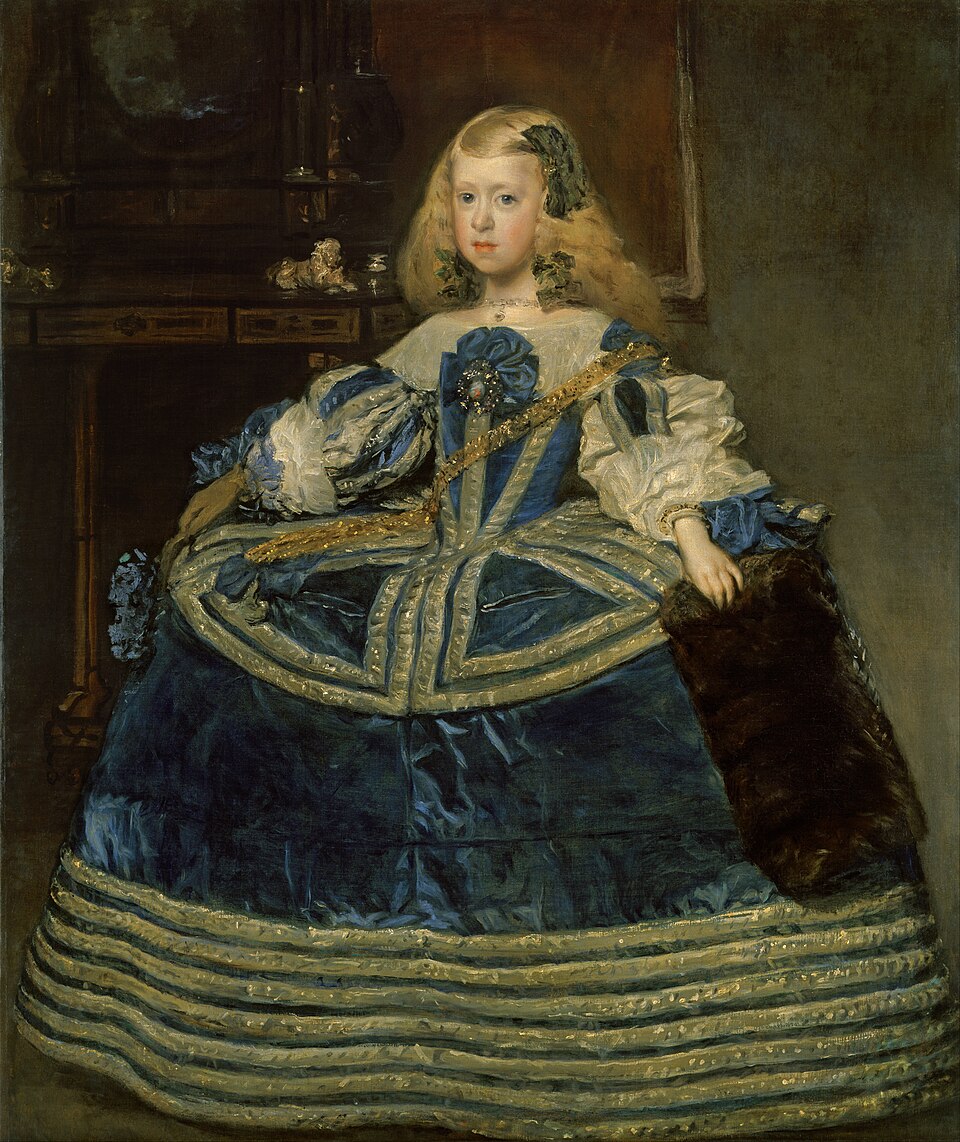
Infanta Margarita Teresa in a Blue Dress, Diego Velázquez, 1659. Image: Wikimedia Commons, public domain Do this: Look at the picture together for a quiet minute before anyone talks.
Read aloud: Velázquez was the court painter of King Philip IV of Spain. This was one of the last portraits he ever painted, the year before he died. If you stand close, the silver trim is only quick dabs and strokes of paint; step back, and it shines like real silver.
Point and find:
- What color is the dress? Say it in Spanish.
- Find the fur muff. What is it for?
- What color is her hair?
- How wide is the skirt? Stretch out your arms to show.
Ask:
- “How do you think it felt to wear such a big dress?”
- “What is the most special outfit you have worn, and why?”
Show: You are wearing a red shirt. Say it in Spanish.
Say this: “Shirt is la camisa; red is rojo, roja after a word ending in -a.”
Say this: “The color goes after the shirt.”
Answer: Llevo una camisa roja.
Show: Margarita is wearing a blue dress. How do you say a blue dress?
Say this: “Dress is el vestido; blue is azul.”
Say this: “Color after the thing.”
Answer: Un vestido azul.
Do this: Ask out loud. Let your child try first; help only after a real try.
Ask: What is el sombrero?
Listen for: The hat.
Ask: What are los zapatos?
Listen for: The shoes.
Ask: How do you say the coat in Spanish?
Listen for: El abrigo.
3 more on the lesson page.
Read aloud: Make a paper doll and a set of clothes, and dress it while saying the clothes in Spanish.
Steps:
- Draw and cut out a simple paper doll from cardstock.
- Draw and cut out clothes for it: a shirt, pants, a dress, shoes, a hat and a coat. Color them.
- A parent writes the Spanish name on the back of each piece. Trace them.
- Dress the doll, saying each piece in Spanish with its color: una camisa verde, un sombrero negro.
- Make a blue dress like Margarita's for the doll.
Tips for you:
- Keep the clothes in an envelope labeled la ropa.
- Have the doll say Llevo... about its clothes.
Done when your child can say:
- I made at least five clothes for my doll.
- I can say what the doll is wearing, with colors.
Do this: Your child picks one or more; you write the date.
- Draw yourself in today's clothes. Label each piece in Spanish with its color.
- Copy: Llevo una camisa ___.
Read aloud: In Mexico and Central America, many women and girls still wear the beautiful huipil, a loose blouse woven and embroidered by hand in bright patterns. Each village has its own patterns, so a person who knows them can tell where a huipil was made.
- Putting the color first: azul camisa. In Spanish the color follows: camisa azul.
- Saying llevo with an l. The ll sounds like y: YEH-boh.
Put dress-up clothes in a basket across the room. The parent calls a piece in Spanish (¡el sombrero!), and the child runs, finds it, puts it on and says Llevo el sombrero. Keep going until the child is wearing everything, then take it all off, naming each piece.
Say this: “Tell me what you learned today.”
Listen for: Name clothes in Spanish: la camisa, los pantalones, el vestido, los zapatos, el sombrero, el abrigo.; Say Llevo... (I am wearing...) with a color.; Learn what Christians are to put on above all things.
And above all these things put on charity, which is the bond of perfectness.
In the Spanish Bible this verse says Y sobre todas estas cosas vestíos de caridad: and above all these things, clothe yourselves with charity. Vestíos comes from the same family as vestido, dress! Love is the finest clothing a Christian can wear.
Spread over the week
3 sessions of 15–20 minutes. Stop while it is still going well.
- Session 1. Warm-up, then read and teach the new idea and the new words. Picture study and show how.
- Session 2. Practice together, then start the project. Finish the project, then the sketchbook.
- Session 3. Narration, the game and the Scripture.