Parent guide · Grade 2 Spanish · Unit 2
Lesson 2.2 Seasons and Months
Written for the parent. The Read aloud parts are written to your child; read them as they are. Do this parts are for you. Answers for you are marked Listen for.
At a glance
- Time
- 3 sessions of 15–20 minutes
- Goal
- Name the four seasons: la primavera, el verano, el otoño, el invierno. Say the twelve months of the year in Spanish. Say in what month your birthday is.
- You need
- A large sheet of paper
- Crayons or markers
- Optional: tissue paper, cotton balls
- A sketchbook or plain paper, and crayons
- A King James Bible
- Worksheet A · the lesson page (it also has a short video (2:18))
Steps
Do this together: What season is it now? What is the weather like? What do you wear? When is your birthday? Today you learn the seasons and the months in Spanish.
Read aloud: The story. About two hundred and forty years ago, the young painter Francisco de Goya was given a big job by the royal tapestry factory in Madrid. The prince of Spain wanted new tapestries, woven wall hangings, for the dining room of his palace, and Goya was to paint the full-size designs. He painted the four seasons. This is spring, la primavera. Out in the bright countryside, a lady in a blue skirt and a black shawl stands holding the hand of a little girl. A young woman kneels on the grass and holds up a pink rose to her. Behind them, a man smiles and lifts his finger to his lips as if keeping a secret: he is hiding a rabbit behind his back to surprise them! A young tree is putting out its first green leaves, and far away the mountains are blue. Goya painted summer, autumn and winter too, each with its own work and weather.
Read aloud: How Spanish sounds. In Spanish, the seasons and months begin with small letters: enero, febrero, marzo. Many months sound like English: abril, agosto, octubre, noviembre, diciembre. Otoño has the ñ: oh-TOH-nyoh. Julio and junio have the breathy j: HOO-lyoh, HOO-nyoh.
Read aloud: Say it and move. Act out the seasons: smell a flower for la primavera, fan yourself for el verano, let your hands fall like leaves for el otoño, and shiver for el invierno. Then march around the room saying the months, one step for each.
Do this: Say each word clearly; your child says it back twice. Point to a picture or the real thing when you can.
- la primavera [lah pree-mah-BEH-rah]: spring
- el verano [ehl beh-RAH-noh]: summer
- el otoño [ehl oh-TOH-nyoh]: autumn, fall
- el invierno [ehl een-BYEHR-noh]: winter
- el mes [ehl MEHS]: the month
- el año [ehl AH-nyoh]: the year
- el cumpleaños [ehl koom-pleh-AH-nyohs]: the birthday
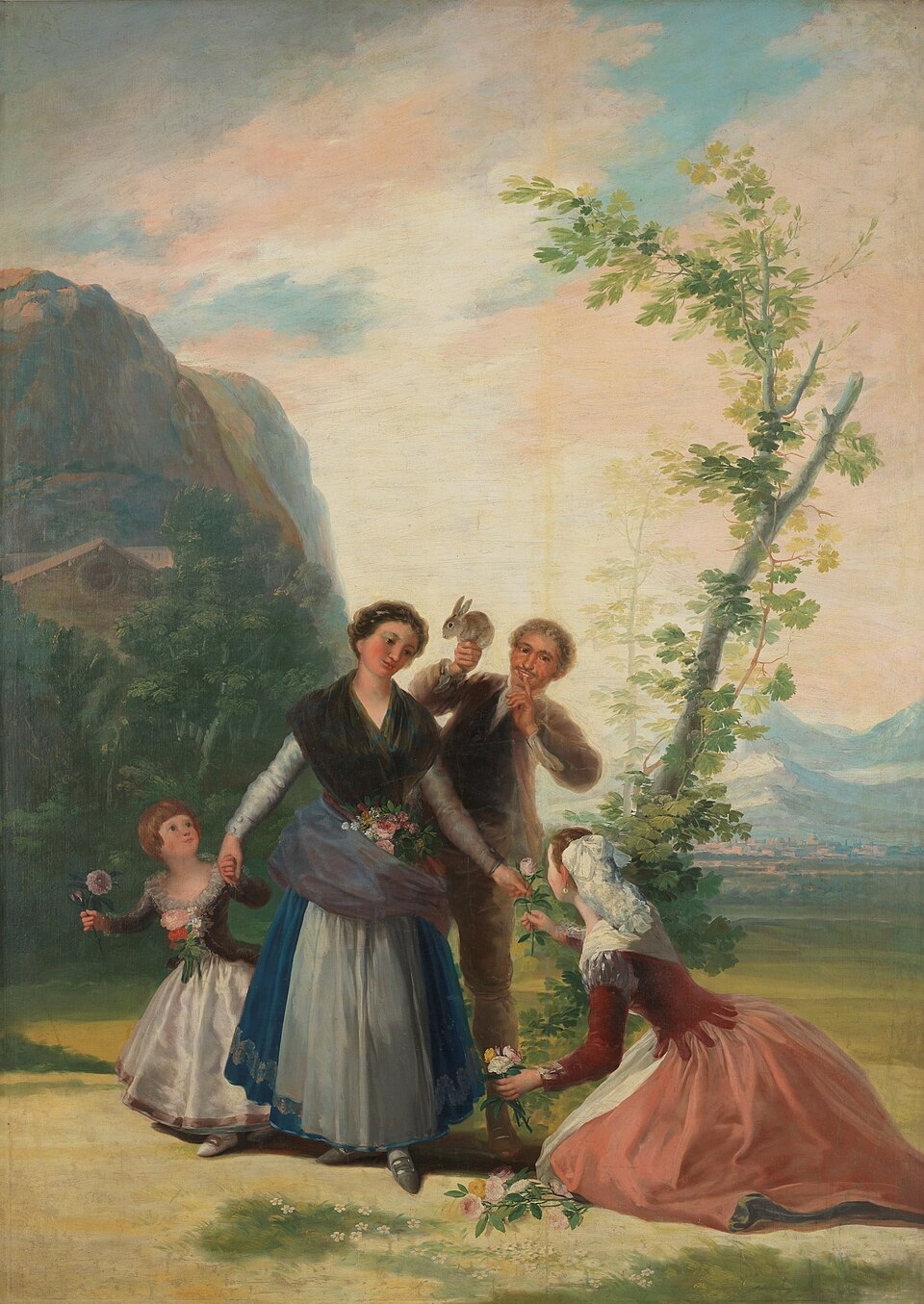
The Flower Girls (Spring), Francisco de Goya, 1786–87. Image: Wikimedia Commons, public domain Do this: Look at the picture together for a quiet minute before anyone talks.
Read aloud: Goya painted this as the full-size design for a tapestry for the dining room of the Prince of Asturias at the palace of El Pardo, near Madrid. The weavers copied it in wool and silk. It was one of a set of four, one for each season.
Point and find:
- Find the kneeling woman. What is she holding up?
- Find the man behind them. What is he hiding?
- Find the little girl. Whose hand is she holding?
- What season is it? How can you tell?
Ask:
- “Why do you think the man is keeping a secret?”
- “What is your favorite season, and why?”
Show: It is very hot and there is no school. What season is it, in Spanish?
Say this: “Hot and no school means summer.”
Say this: “Summer is el verano.”
Answer: El verano.
Show: Your birthday is in May. Say it in Spanish.
Say this: “May is mayo, with a small letter.”
Say this: “My birthday is: Mi cumpleaños es en...”
Answer: Mi cumpleaños es en mayo.
Do this: Ask out loud. Let your child try first; help only after a real try.
Ask: What is el invierno?
Listen for: Winter.
Ask: What is la primavera?
Listen for: Spring.
Ask: How do you say autumn in Spanish?
Listen for: El otoño.
3 more on the lesson page.
Read aloud: Fold a paper into four and draw the same tree in each season, labeled in Spanish.
Steps:
- Fold the paper into four squares.
- Draw the same tree in each square: with flowers and new leaves (la primavera), full and green (el verano), with orange and red leaves falling (el otoño), bare with snow (el invierno).
- Label each square in Spanish.
- Under each season, write its three months in Spanish (a parent can help, depending on where you live).
- Point to your birthday month and say: Mi cumpleaños es en...
Tips for you:
- Glue cotton for snow and tissue paper for leaves.
- Draw what you wear in each season beside the tree.
Done when your child can say:
- I drew and labeled all four seasons in Spanish.
- I can say the twelve months in order.
Do this: Your child picks one or more; you write the date.
- Write the four seasons in Spanish and draw a picture for each.
- Copy: Mi cumpleaños es en ___.
Read aloud: On the other side of the equator, in Argentina, Chile and Uruguay, the seasons are turned around: el verano, summer, comes in diciembre, enero and febrero, and the long summer school holidays begin around Christmas.
- Writing months with capital letters. In Spanish, enero and julio begin with small letters.
- Mixing up junio and julio. Junio (June) has n like June; julio (July) has l like July.
Write the twelve months in Spanish on twelve cards and mix them up. Time the child putting them in order on the floor, saying each one aloud. Then play again and try to beat the time.
Say this: “Tell me what you learned today.”
Listen for: Name the four seasons: la primavera, el verano, el otoño, el invierno.; Say the twelve months of the year in Spanish.; Say in what month your birthday is.
Thou hast set all the borders of the earth: thou hast made summer and winter.
In the Spanish Bible this verse ends el verano y el invierno tú los formaste: the summer and the winter, you made them. Every season, with its own beauty, comes from God.
Spread over the week
3 sessions of 15–20 minutes. Stop while it is still going well.
- Session 1. Warm-up, then read and teach the new idea and the new words. Picture study and show how.
- Session 2. Practice together, then start the project. Finish the project, then the sketchbook.
- Session 3. Narration, the game and the Scripture.