Parent guide · Grade 2 Spanish · Unit 3
Lesson 3.1 Breakfast
Written for the parent. The Read aloud parts are written to your child; read them as they are. Do this parts are for you. Answers for you are marked Listen for.
At a glance
- Time
- 3 sessions of 15–20 minutes
- Goal
- Name breakfast foods in Spanish: el pan, la leche, el huevo, el jugo, el cereal, la fruta. Say Tengo hambre (I am hungry). Ask politely: Quiero..., por favor.
- You need
- A sheet of paper folded in half
- Crayons or markers
- Old magazines or grocery flyers (optional)
- A sketchbook or plain paper, and crayons
- A King James Bible
- Worksheet A · the lesson page (it also has a short video (2:27))
Steps
Do this together: What did you eat for breakfast this morning? Bread? Eggs? Cereal? Milk? Today you learn the names of breakfast foods in Spanish.
Read aloud: The story. Bartolomé Esteban Murillo grew up in Seville, a great city in the south of Spain, as the youngest of fourteen children. When he was still a boy, his father and mother both died, and he was raised by his older sister and her husband. Perhaps that is why, when he became a painter, he loved to paint the poor children of Seville. In this painting two boys sit on a stone step. One holds a piece of pie high above his head and drops it into his open mouth. The other boy, smiling, reaches for another piece from the pie dish. Their clothes are old and torn, their feet are bare, but they are happy: they have something to eat! A little dog sits by them, looking up hopefully, and at their feet is a basket with fruit and a loaf of bread wrapped in a cloth.
Read aloud: How Spanish sounds. Huevo begins with a soft w sound: WEH-boh. Jugo and hambre look alike but sound different: in jugo the j is a breathy h (HOO-goh); in hambre the h is quiet (AHM-breh). Leche is LEH-cheh.
Read aloud: Say it and move. Rub your tummy: Tengo hambre. Pretend to bite bread: el pan. Drink from a cup: la leche, el jugo. Crack an egg: el huevo. Then hold out your hands like a plate: Quiero pan, por favor.
Do this: Say each word clearly; your child says it back twice. Point to a picture or the real thing when you can.
- el desayuno [ehl deh-sah-YOO-noh]: breakfast
- el pan [ehl PAHN]: the bread
- la leche [lah LEH-cheh]: the milk
- el huevo [ehl WEH-boh]: the egg
- el jugo [ehl HOO-goh]: the juice
- la fruta [lah FROO-tah]: the fruit
- tengo hambre [TEHN-goh AHM-breh]: I am hungry
- quiero [KYEH-roh]: I want
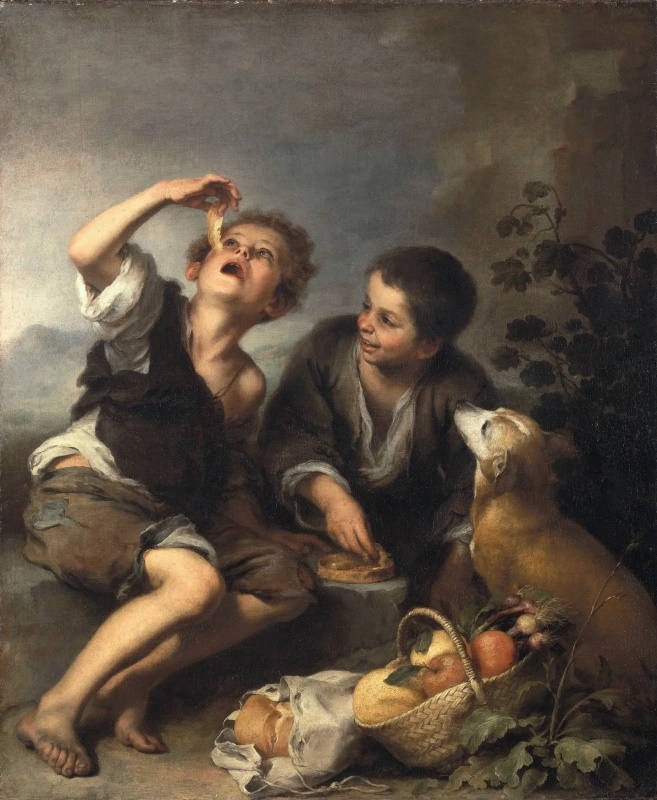
The Pie Eaters, Bartolomé Esteban Murillo, about 1670–75. Image: Wikimedia Commons, public domain Do this: Look at the picture together for a quiet minute before anyone talks.
Read aloud: Murillo painted many pictures of poor children in Seville, and people in Flanders, Germany and England loved them. This one was bought by a German prince long ago and is now in Munich.
Point and find:
- Find the boy eating the pie. How is he eating it?
- Find the dog. What does it want?
- Find the basket. What is in it?
- Find the bread. Say el pan.
Ask:
- “The boys are poor, but they are smiling. Why?”
- “How can we thank God for the food we have every day?”
Show: You want bread. Ask for it politely.
Say this: “I want is quiero; bread is pan.”
Say this: “Add por favor.”
Answer: Quiero pan, por favor.
Show: You are very hungry. Say it in Spanish.
Say this: “Spanish says I have hunger: tengo hambre.”
Answer: Tengo hambre.
Do this: Ask out loud. Let your child try first; help only after a real try.
Ask: What is la leche?
Listen for: The milk.
Ask: What is el huevo?
Listen for: The egg.
Ask: How do you say breakfast in Spanish?
Listen for: El desayuno.
3 more on the lesson page.
Read aloud: Make a breakfast menu in Spanish, with pictures, for the family restaurant.
Steps:
- On the cover, write El desayuno and draw a sun.
- Inside, draw or glue pictures of breakfast foods: bread, milk, eggs, juice, cereal, fruit.
- Copy the Spanish name under each.
- Play restaurant: the family reads the menu and orders in Spanish: Quiero un huevo, por favor.
- Serve pretend food and answer: Aquí tienes (Here you are).
Tips for you:
- Add prices in pesos using the numbers you know.
- Use the menu for the real breakfast at the end of the unit.
Done when your child can say:
- My menu has six breakfast foods in Spanish.
- I can order politely in Spanish.
Do this: Your child picks one or more; you write the date.
- Draw your breakfast plate and cup. Label each food in Spanish.
- Copy: Tengo hambre.
Read aloud: In Spain, breakfast is often small: bread toasted with olive oil and tomato, or churros dipped in thick hot chocolate. In Mexico, breakfast can be big, with eggs, beans and tortillas. The biggest meal of the day in many Spanish-speaking countries is lunch, la comida, in the middle of the day.
- Saying huevo with an h. The h is silent: WEH-boh.
- Saying I am hungry as soy hambre. Spanish says tengo hambre: I have hunger.
Put real or pretend foods in a basket. The child closes his or her eyes, takes one out, feels or smells it, and guesses in Spanish: ¡Es el pan! Then open your eyes to check. Take turns.
Say this: “Tell me what you learned today.”
Listen for: Name breakfast foods in Spanish: el pan, la leche, el huevo, el jugo, el cereal, la fruta.; Say Tengo hambre (I am hungry).; Ask politely: Quiero..., por favor.
They are new every morning: great is thy faithfulness.
In the Spanish Bible this verse says Nuevas son cada mañana; grande es tu fidelidad: they are new every morning; great is your faithfulness. Every breakfast is a reminder that God's mercies are new every morning.
Spread over the week
3 sessions of 15–20 minutes. Stop while it is still going well.
- Session 1. Warm-up, then read and teach the new idea and the new words. Picture study and show how.
- Session 2. Practice together, then start the project. Finish the project, then the sketchbook.
- Session 3. Narration, the game and the Scripture.