Parent guide · Grade 2 Spanish · Unit 3
Lesson 3.2 I Like, I Don't Like
Written for the parent. The Read aloud parts are written to your child; read them as they are. Do this parts are for you. Answers for you are marked Listen for.
At a glance
- Time
- 3 sessions of 15–20 minutes
- Goal
- Ask ¿Te gusta...? (Do you like...?). Answer Sí, me gusta or No, no me gusta. Name vegetables and fruits in a Spanish still life.
- You need
- Paper and a ruler
- Crayons or markers
- A sketchbook or plain paper, and crayons
- A King James Bible
- Worksheet A · the lesson page (it also has a short video (3:30))
Steps
Do this together: What food do you like best? What food do you not like at all? Today you learn to say both in Spanish, and to ask other people what they like.
Read aloud: The story. More than four hundred years ago in Toledo, Spain, there lived a painter named Juan Sánchez Cotán. He painted food: simple vegetables and fruits set in a window, glowing against the dark. In this painting, three yellow lemons hang on a leafy branch at the top. In the middle, apples dangle on strings. Birds hang from the top, ready for supper. Long carrots lie on the ledge, and a huge pale cardoon, a vegetable like celery, curls up at the right. Everything is arranged so carefully that it looks like a song made of food. Soon after he painted this, in 1603, Sánchez Cotán gave away his things and went to live as a lay brother in a monastery in Granada, where he spent the rest of his life praying, working and painting pictures for the monastery.
Read aloud: How Spanish sounds. To ask a friend, say ¿Te gusta el limón? (Do you like the lemon?), with your voice going up at the end. To answer, say Sí, me gusta or No, no me gusta. Yes, there are two no's! For more than one thing, add n: Me gustan las zanahorias.
Read aloud: Say it and move. Thumbs up and a big smile: ¡Sí, me gusta! Thumbs down and a funny face: ¡No, no me gusta! Point to a friend with a questioning look: ¿Te gusta?
Do this: Say each word clearly; your child says it back twice. Point to a picture or the real thing when you can.
- ¿te gusta? [teh GOO-stah]: do you like?
- me gusta [meh GOO-stah]: I like
- no me gusta [noh meh GOO-stah]: I don't like
- la zanahoria [lah sah-nah-OH-ryah]: the carrot
- el limón [ehl lee-MOHN]: the lemon
- la manzana [lah mahn-SAH-nah]: the apple
- dulce [DOOL-seh]: sweet
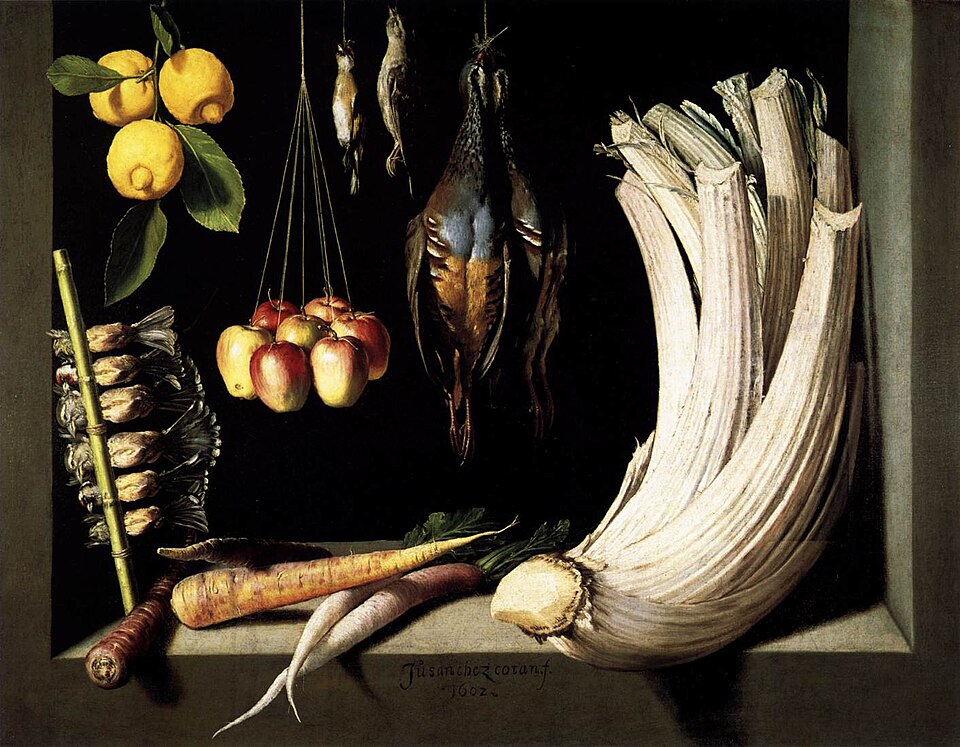
Still Life with Game, Vegetables and Fruit, Juan Sánchez Cotán, 1602. Image: Wikimedia Commons, public domain Do this: Look at the picture together for a quiet minute before anyone talks.
Read aloud: Sánchez Cotán signed and dated this painting on the stone ledge: 1602. He placed every fruit and vegetable in light against the dark, so that ordinary food looks almost holy. Painters still study how he arranged it.
Point and find:
- Count the lemons in Spanish.
- Find the apples. What are they hanging from?
- Find the carrots. What color are they?
- Find the big pale vegetable. It is a cardoon. Does it look like celery?
Ask:
- “Which food in the painting would you like to eat? Which would you not?”
- “Why do you think he painted ordinary food so carefully?”
Show: Ask your friend if he likes carrots... one carrot.
Say this: “Do you like is te gusta.”
Say this: “The carrot is la zanahoria.”
Answer: ¿Te gusta la zanahoria?
Show: You do not like lemons. Answer ¿Te gusta el limón?
Say this: “Answer no, then no me gusta.”
Answer: No, no me gusta.
Do this: Ask out loud. Let your child try first; help only after a real try.
Ask: What does ¿Te gusta? mean?
Listen for: Do you like?
Ask: How do you say Yes, I like it?
Listen for: Sí, me gusta.
Ask: What is la zanahoria?
Listen for: The carrot.
3 more on the lesson page.
Read aloud: Ask your family about foods in Spanish and make a chart of their answers.
Steps:
- Draw a chart: names of family members down the side, five foods across the top (el pan, la zanahoria, el limón, la manzana, la leche).
- Ask each person: ¿Te gusta el limón?
- Draw a smiley face for Sí, me gusta and a frowning face for No, no me gusta.
- Count the smiles for each food in Spanish.
- Tell the family which food is the favorite.
Tips for you:
- Ask a grandparent or friend by phone, in Spanish.
- Add a food you have never tried, and try it!
Done when your child can say:
- I asked at least three people about five foods in Spanish.
- I can say the results with me gusta and no me gusta.
Do this: Your child picks one or more; you write the date.
- Draw a food you like and write Me gusta ___.
- Draw a food you don't like and write No me gusta ___.
Read aloud: The Spanish brought many foods from the Americas back to Europe: tomatoes, potatoes, corn, chocolate, peppers and vanilla. Before Columbus, no one in Spain had ever tasted a tomato or a potato!
- Saying yo gusta. Spanish says me gusta.
- Forgetting the second no. Answer No, no me gusta.
The parent names a food in Spanish. If the child likes it, he or she jumps up and says ¡Sí, me gusta!; if not, the child crouches down and says ¡No, no me gusta! Go faster and faster, and include silly foods: ¿Te gusta el jabón? (soap)
Say this: “Tell me what you learned today.”
Listen for: Ask ¿Te gusta...? (Do you like...?).; Answer Sí, me gusta or No, no me gusta.; Name vegetables and fruits in a Spanish still life.
How sweet are thy words unto my taste! yea, sweeter than honey to my mouth!
In the Spanish Bible this verse begins ¡Cuán dulces son á mi paladar tus palabras!: how sweet are your words to my taste! We like many foods, but God's words are sweeter than honey.
Spread over the week
3 sessions of 15–20 minutes. Stop while it is still going well.
- Session 1. Warm-up, then read and teach the new idea and the new words. Picture study and show how.
- Session 2. Practice together, then start the project. Finish the project, then the sketchbook.
- Session 3. Narration, the game and the Scripture.