Parent guide · Grade 2 Spanish · Unit 4
Lesson 4.1 How Are You Feeling?
Written for the parent. The Read aloud parts are written to your child; read them as they are. Do this parts are for you. Answers for you are marked Listen for.
At a glance
- Time
- 3 sessions of 15–20 minutes
- Goal
- Ask ¿Cómo estás?; Answer Estoy feliz, triste, cansado, enojado, bien.; Learn to rejoice in the Lord always.
- You need
- Four paper plates
- Crayons or markers
- Craft sticks and tape
- A sketchbook or plain paper, and crayons
- A King James Bible
- Worksheet A · the lesson page (it also has a short video (1:23))
Steps
Do this together: How do you feel today? Happy? Tired? Hungry? Show me with your face. Today you learn to say how you feel in Spanish.
Read aloud: The story. Murillo, who painted the boys eating pie, also painted this boy with his dog. The boy has a basket on his arm, and he is on his way somewhere, perhaps to the market. He has stopped to look down at a little dog, and he cannot stop grinning! He holds out his hand toward it, as if to say, Look what I have, or Come here, friend. We can only see the dog's head at the bottom corner, looking up at him. The boy's clothes are simple and his sleeves are worn, but his face is full of joy. This painting now hangs in a great museum in Saint Petersburg, in Russia, far from Seville, and people still smile when they see that boy smile.
Read aloud: How Spanish sounds. For feelings, Spanish uses estoy (I am): Estoy feliz. Some feelings change at the end for girls: a boy says Estoy cansado; a girl says Estoy cansada. Feliz and triste stay the same for everyone. The z in feliz sounds like s: feh-LEES.
Read aloud: Say it and move. Big smile and arms up: Estoy feliz. Droopy face, pretend tears: Estoy triste. Yawn and stretch: Estoy cansado. Crossed arms and a frown: Estoy enojado. Thumbs up: Estoy bien.
Do this: Say each word clearly; your child says it back twice. Point to a picture or the real thing when you can.
- ¿cómo estás? [KOH-moh ehs-TAHS]: how are you?
- estoy [ehs-TOY]: I am (for feelings)
- feliz [feh-LEES]: happy
- triste [TREES-teh]: sad
- cansado [kahn-SAH-doh]: tired
- enojado [eh-noh-HAH-doh]: angry
- bien [BYEHN]: well, fine
- el perro [ehl PEH-rroh]: the dog
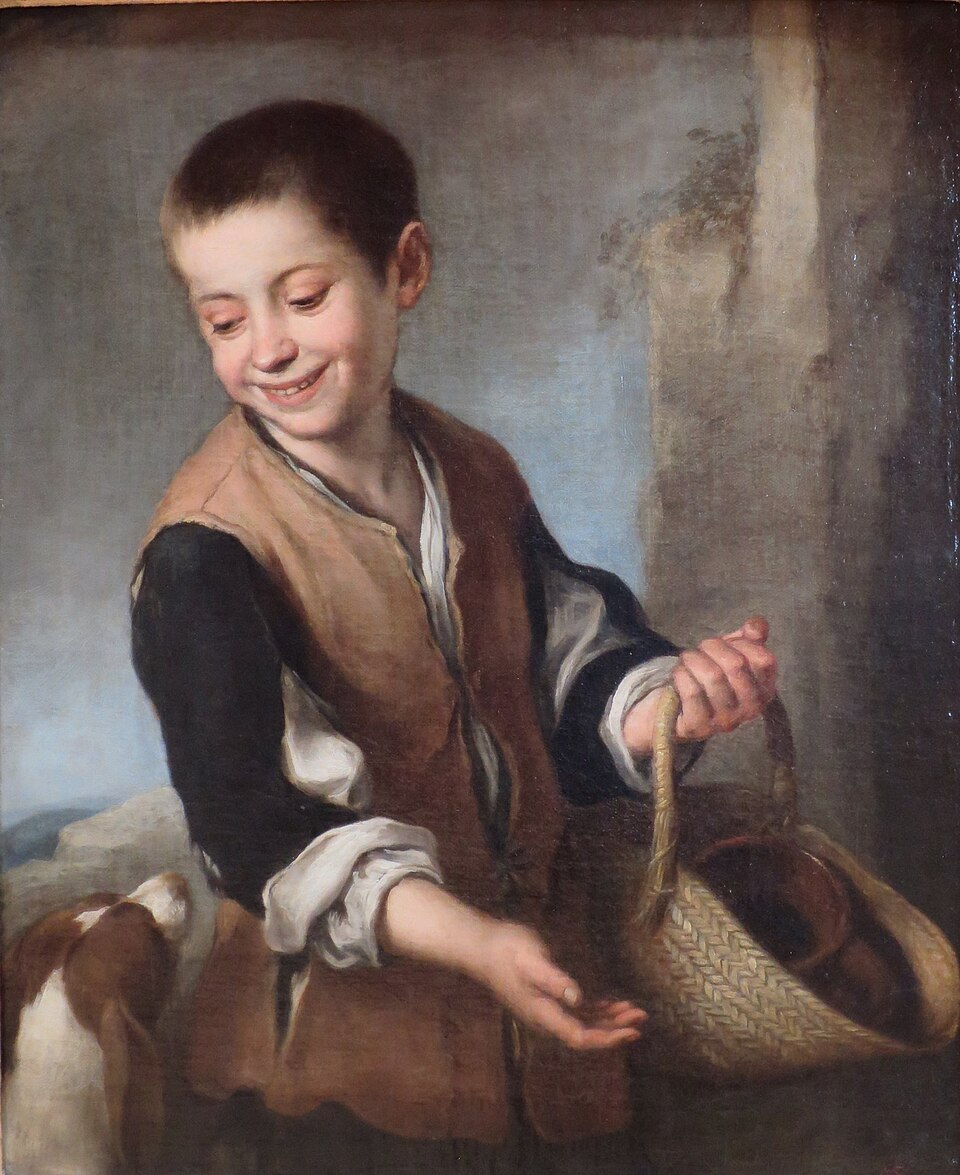
Boy with a Dog, Bartolomé Esteban Murillo, about 1655–60. Image: Wikimedia Commons, public domain Do this: Look at the picture together for a quiet minute before anyone talks.
Read aloud: Murillo painted this boy as a pair with a painting of a girl selling fruit, which is now in Moscow. He loved to show the cheerful faces of ordinary children, painted with warm, soft colors.
Point and find:
- How does the boy feel? Say it in Spanish.
- Find the dog. How does the dog feel?
- What is the boy carrying?
- What do you think the boy is saying to the dog?
Ask:
- “What makes you happy, like this boy?”
- “How can we choose joy even when we are tired or sad?”
Show: You just woke up and want to go back to bed. ¿Cómo estás?
Say this: “Sleepy and worn out is tired: cansado (boy) or cansada (girl).”
Answer: Estoy cansado. / Estoy cansada.
Show: Grandma asks ¿Cómo estás? and you feel great. Answer.
Say this: “Great or well is bien; happy is feliz.”
Answer: Estoy bien, gracias. / Estoy feliz.
Do this: Ask out loud. Let your child try first; help only after a real try.
Ask: What is feliz?
Listen for: Happy.
Ask: What is triste?
Listen for: Sad.
Ask: How do you ask How are you? in Spanish?
Listen for: ¿Cómo estás?
3 more on the lesson page.
Read aloud: Make paper-plate faces for feelings and use them every day.
Steps:
- Draw a different face on each plate: happy, sad, tired and angry.
- Write the Spanish word on the back: feliz, triste, cansado/cansada, enojado/enojada.
- Tape a craft stick to each plate as a handle.
- Have someone ask ¿Cómo estás?, and hold up the face that shows how you feel: Estoy feliz.
- Ask the family and let them answer with the plates.
Tips for you:
- Use the plates at breakfast every day this week.
- Add a fifth plate: Estoy bien.
Done when your child can say:
- I made four feelings faces with Spanish words.
- I can ask and answer ¿Cómo estás?
Do this: Your child picks one or more; you write the date.
- Draw four faces and label them feliz, triste, cansado, enojado.
- Draw the boy and his dog and write Estoy feliz.
Read aloud: In Spanish-speaking countries, people usually greet friends with a kiss on the cheek (in Spain, one on each cheek) and ask ¿Cómo estás? or ¿Qué tal? It would be rude to begin talking about anything else before greeting.
- Saying soy feliz for how you feel right now. For feelings, use estoy: Estoy feliz.
- A girl saying cansado. A girl says cansada.
One player makes a feelings face without speaking. The other asks ¿Estás triste? ¿Estás feliz? until guessing right, and the first player answers Sí, estoy... or No. Then switch.
Say this: “Tell me what you learned today.”
Listen for: Ask ¿Cómo estás?; Answer Estoy feliz, triste, cansado, enojado, bien.; Learn to rejoice in the Lord always.
Rejoice in the Lord alway: and again I say, Rejoice.
In the Spanish Bible this verse says Gozaos en el Señor siempre: otra vez digo: Que os gocéis: rejoice in the Lord always; again I say, rejoice. Gozo is joy. Even when we are triste or cansado, we can rejoice that the Lord is with us.
Spread over the week
3 sessions of 15–20 minutes. Stop while it is still going well.
- Session 1. Warm-up, then read and teach the new idea and the new words. Picture study and show how.
- Session 2. Practice together, then start the project. Finish the project, then the sketchbook.
- Session 3. Narration, the game and the Scripture.