Parent guide · Grade 2 Spanish · Unit 4
Lesson 4.2 Run, Jump, Climb
Written for the parent. The Read aloud parts are written to your child; read them as they are. Do this parts are for you. Answers for you are marked Listen for.
At a glance
- Time
- 3 sessions of 15–20 minutes
- Goal
- Do and say action words: corre, salta, camina, sube, baila. Follow and give commands: siéntate, levántate. Learn the promise of Isaiah 40:31.
- You need
- A square box (a tissue box) or a paper cube
- Paper, markers and tape
- A sketchbook or plain paper, and crayons
- A King James Bible
- Worksheet A · the lesson page (it also has a short video (1:52))
Steps
Do this together: Stand up! Can you run in place? Jump? Climb an imaginary ladder? Today you learn the Spanish words for things you do with your whole body.
Read aloud: The story. Francisco de Goya painted many happy scenes of children playing for the royal tapestry factory. In this one, three boys want to reach the branches of a tall tree. The trunk is too high to climb alone, so they work together! One boy bends over and puts his hands on his knees. A second boy, in white, stands on his back. And the third boy, in brown, has climbed up onto the second boy and is reaching up into the branches. On the ground lies a hat someone dropped. Behind them, a round stone tower and distant blue mountains stand under a pale sky. Goya painted this as a design for a tapestry for the king's palace of El Escorial.
Read aloud: How Spanish sounds. When you tell a friend to do something, Spanish often uses a word ending in -a or -e: corre (run!), salta (jump!), baila (dance!), sube (climb!). Siéntate and levántate lean where the accent is: SYEHN-tah-teh, leh-BAHN-tah-teh. In corre, roll the rr.
Read aloud: Say it and move. Do each action as you say it: ¡Camina! (walk in place), ¡Corre! (run in place), ¡Salta! (jump), ¡Sube! (climb an imaginary ladder), ¡Baila! (dance), ¡Siéntate! (sit down), ¡Levántate! (stand up).
Do this: Say each word clearly; your child says it back twice. Point to a picture or the real thing when you can.
- corre [KOH-rreh]: run!
- camina [kah-MEE-nah]: walk!
- salta [SAHL-tah]: jump!
- sube [SOO-beh]: climb! go up!
- baila [BYE-lah]: dance!
- siéntate [SYEHN-tah-teh]: sit down!
- levántate [leh-BAHN-tah-teh]: stand up!
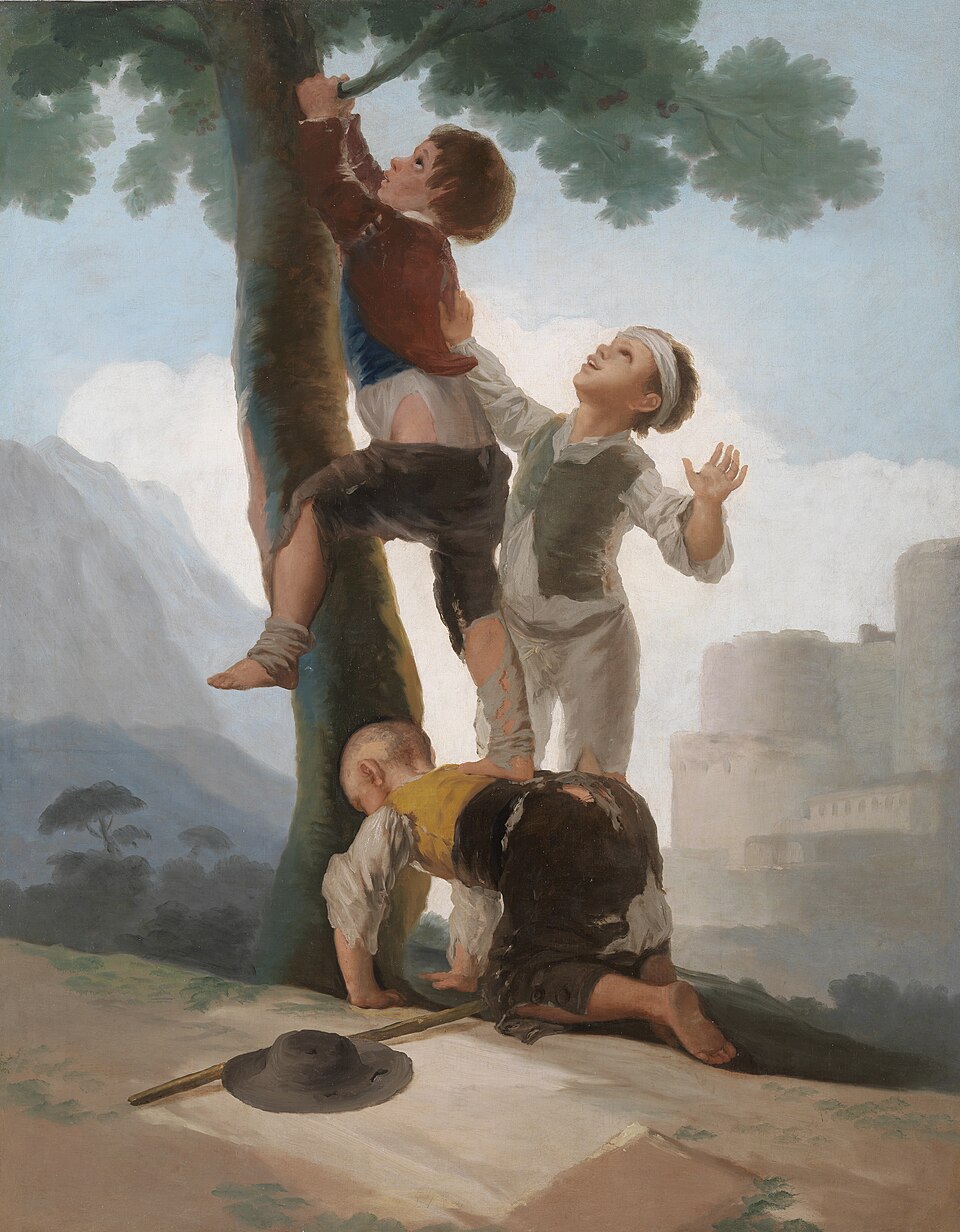
Boys Climbing a Tree, Francisco de Goya, 1791–92. Image: Wikimedia Commons, public domain Do this: Look at the picture together for a quiet minute before anyone talks.
Read aloud: Goya painted this as the full-size design for a tapestry for a room at the palace of El Escorial. It is one of the last of his tapestry designs. He liked to show children helping one another in their games.
Point and find:
- Count the boys in Spanish.
- Find the boy at the bottom. What is he doing?
- Find the boy climbing. Say sube.
- Find the hat on the ground.
Ask:
- “Why could the boys reach the branches only by working together?”
- “When has someone helped you do something hard?”
Show: You want your little brother to sit down. Tell him in Spanish.
Say this: “Sit down is siéntate.”
Answer: ¡Siéntate!
Show: The coach says ¡Salta! What do you do?
Say this: “Salta means jump.”
Answer: You jump.
Do this: Ask out loud. Let your child try first; help only after a real try.
Ask: What is corre?
Listen for: Run!
Ask: What is baila?
Listen for: Dance!
Ask: How do you say Jump! in Spanish?
Listen for: ¡Salta!
3 more on the lesson page.
Read aloud: Make a big die with an action on each side, roll it, and do what it says.
Steps:
- Cover the box with plain paper.
- On each of the six sides, write an action and draw a stick figure doing it: corre, salta, camina, sube, baila, siéntate.
- Roll the die.
- Read the action aloud and do it for ten seconds, counting in Spanish.
- Take turns with the family.
Tips for you:
- Make a second die with numbers for how many times to do the action.
- Play outside in the yard.
Done when your child can say:
- My die has six actions in Spanish.
- I can read and do every action.
Do this: Your child picks one or more; you write the date.
- Draw yourself doing three actions. Label them in Spanish.
- Draw the three boys and write suben al árbol (they climb the tree).
Read aloud: Children in Spanish-speaking countries love fútbol (soccer) more than any other sport. You will hear ¡Corre! and ¡Gol! shouted on every playground, from Spain to Mexico to Argentina.
- Saying corre with a single r. Roll the rr: KOH-rreh.
- Saying siéntate with the stress on the end. Lean on the first part: SYEHN-tah-teh.
The leader gives commands in Spanish: Simón dice: ¡salta! Simón dice: ¡baila! If the leader does not say Simón dice first, don't move! Take turns being Simón.
Say this: “Tell me what you learned today.”
Listen for: Do and say action words: corre, salta, camina, sube, baila.; Follow and give commands: siéntate, levántate.; Learn the promise of Isaiah 40:31.
But they that wait upon the LORD shall renew their strength; they shall mount up with wings as eagles; they shall run, and not be weary; and they shall walk, and not faint.
In the Spanish Bible this verse ends correrán, y no se cansarán; caminarán, y no se fatigarán: they shall run and not be weary; they shall walk and not faint. Find corre and camina hidden inside correrán and caminarán, and cansado inside cansarán!
Spread over the week
3 sessions of 15–20 minutes. Stop while it is still going well.
- Session 1. Warm-up, then read and teach the new idea and the new words. Picture study and show how.
- Session 2. Practice together, then start the project. Finish the project, then the sketchbook.
- Session 3. Narration, the game and the Scripture.